
Formulating the Audit Opinion

An Integrated Framework for Auditor Reporting, Communication Mechanisms, and Regulatory Oversight
An Independent Auditor’s Report is not merely the concluding document of an audit or a prescribed reporting format; it is the formal communication of the auditor’s professional judgment on the financial statements. It represents the culmination of a structured process involving the evaluation of sufficient appropriate audit evidence, identified misstatements, materiality and pervasiveness, going concern, adequacy of disclosures, comparative information and other matters relevant to the auditor’s conclusion. The report therefore does more than state an opinion it communicates the auditor’s conclusion and its relevant context to shareholders, those charged with governance, regulators and other users of financial information.
The auditor’s reporting framework is principally anchored in SA 700 (Revised) provides the architecture for forming the opinion and reporting, SA 701 addresses Key Audit Matters (KAMs), SA 705 (Revised) determines when and how the opinion is modified, SA 706 (Revised) governs Emphasis of Matter (EOM) and Other Matter paragraphs, SA 710 deals with comparative information, SA 720 (Revised) addresses the auditor’s responsibilities in relation to other information and SA 570 (Revised) governs the auditor’s responsibilities relating to going concern and the reporting consequences of a material uncertainty related to going concern, each addressing a distinct but interconnected aspect of auditor reporting.. While these Standards operate within an integrated reporting framework, they are not interchangeable; each applies to specific circumstances and prescribes distinct requirements for the auditor’s reporting and communication.
In an environment of increasing complexity in transactions and corporate structures, extensive financial reporting requirements and heightened regulatory scrutiny, auditor reporting has become an exercise of significant professional judgment rather than mechanical compliance with a prescribed format. NFRA enforcement actions and QRB observations repeatedly demonstrate that apparent reporting defects often originate earlier in the audit process, inadequate risk assessment, insufficient appropriate audit evidence, weak professional scepticism, poor documentation, failure to evaluate pervasiveness, or conclusions that are not supported by the procedures actually performed. The report is therefore best understood as the visible end-product of an invisible chain of professional judgements
The Auditing and Assurance Standards Board (AASB) of the Institute of Chartered Accountants of India (ICAI) prescribes an integrated framework of engagement standards designed to govern various types of assurance and related services engagements:
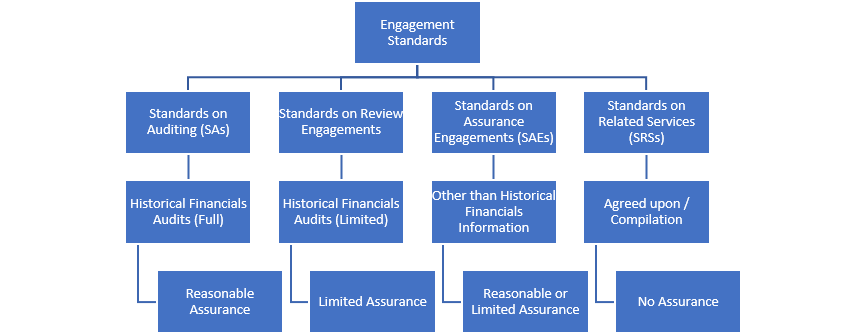
- Standards on Auditing (SAs) to be applied in the audit of historical financial information.
- Standards on Review Engagements (SREs) to be applied in the review of historical financial information to provide limited assurance (e.g., SRE 2410 for interim financial results).
- Standards on Assurance Engagements (SAEs) to be applied in assurance engagements dealing with matters other than historical financial information (e.g., SAE 3400 for prospective financial information, SAE 3420 for proforma information).
- Standards on Related Services (SRSs) to be applied to engagements involving application of agreed-upon procedures (SRS 4400) or compilation engagements (SRS 4410).
Collectively, these Standards establish the professional framework within which the practitioner determines the nature, scope and level of assurance or service to be provided.
This article is confined to the reporting framework applicable to audits of historical financial information, with particular emphasis on the formation, evaluation and communication of the auditor’s opinion.
2. Core Reporting Standards for Audit of Historical Financial Information
The auditor’s reporting responsibilities in an audit of historical financial information may broadly be understood through two fundamental questions:
- first, what conclusion should the auditor express on the financial statements; and
- second, what other matters are required to be communicated to users through the auditor’s report?
While these questions provide a useful framework for understanding auditor reporting, the answers are not derived from a single Standard. Rather, the auditor’s report is the product of an interconnected framework of Standards on Auditing, each addressing a distinct aspect of the reporting process of the auditor’s reporting responsibilities.
The first is principally addressed by SA 700 (Revised) and SA 705 (Revised), while the second encompasses SA 701, SA 706 (Revised), SA 710 and SA 720 (Revised) and SA 570 (Revised), each addressing a distinct reporting responsibility.
A useful way to understand the reporting process is divide as under:
| Layer | Principal question | Primary standards / requirements |
| Opinion Formulation | Are the financial statements, as a whole, free from material misstatement and prepared in accordance with the applicable framework? | SA 700 (Revised); SA 705 (Revised); SA 570 (Revised) |
| Modification | If the opinion cannot be unmodified, what form of modification is appropriate? | SA 705 (Revised) |
| Additional communication | What matters must or may be highlighted without changing the opinion? | SA 701; SA 706 (Revised); SA 570 (Revised) |
| Comparative / other information | What additional reporting consequences arise from prior-period information or other information? | SA 710; SA 720 (Revised) |
| Statutory / regulatory reporting | What reporting is separately required by law, rules or sectoral regulation? | Companies Act, 2013; applicable Rules/Orders and other law |
2.1 Seven questions before the report is signed
- Is sufficient appropriate audit evidence available to support the propose opinion?
- Have all identified misstatements been accumulated, evaluated individually and in aggregate, and compared with the applicable materiality thresholds?
- Where there is a material matter, have we assessed whether the effects are pervasive?
- Does any matter affect the appropriateness of the going concern basis or create a material uncertainty related to going concern?
- Where SA 701 applies, which matters communicated with those charged with governance were of most significance in the audit?
- Are there matters requiring EOM or Other Matter reporting under SA 706 (Revised), or specific reporting under SA 710 or SA 720 (Revised)?
- Does the final report agree with the audit file, the financial statements, the communication with those charged with governance and the applicable legal/regulatory reporting requirements?
3. Structure of Independent Auditor’s Report
3.1 SA 700 (Revised) is the foundation of the reporting architecture. It deals with the auditor’s responsibility to form an opinion on the financial statements and prescribes the form and content of the independent Auditor’s Report. The auditor’s objective is not to certify that every amount is correct; it is to express a conclusion, based on the audit evidence obtained, on whether the financial statements as a whole are prepared, in all material respects, in accordance with the applicable financial reporting framework
3.2 Critical Positioning and Reporting Considerations
- Opinion first: The Opinion section is presented at the beginning of the auditor’s report, followed immediately by the Basis for Opinion section. When the auditor modifies the opinion, the “Opinion” section heading is changed to “Qualified Opinion”, “Adverse Opinion” or “Disclaimer of Opinion”, as applicable.
This positioning enables users to identify the auditor’s opinion at the outset rather than having to navigate through extensive explanatory material before understanding the audit outcome.
- Basis for Modification: When the auditor modifies the opinion, the “Basis for Opinion” section heading is changed to “Basis for Qualified Opinion”, “Basis for Adverse Opinion” or “Basis for Disclaimer of Opinion”, as applicable. The section explains the matter giving rise to the modification and, where practicable, describes or quantifies its financial impact.
- Statutory and regulatory reporting: In India, the auditor’s statutory and regulatory reporting responsibilities under Section 143(3) of the Companies Act, 2013 (‘the Act’), including reporting on internal financial controls with reference to financial statements, and under CARO 2020, are generally presented separately under “Report on Other Legal and Regulatory Requirements.” For Government companies or Government-controlled entities, additional reporting may arise under Section 143(5), including directions issued by the CAG. Such reporting is distinct from the auditor’s opinion on the financial statements; however, the auditor must separately assess whether any matter also requires modification of the opinion under the applicable Standards on Auditing.
- Mandatory Sign-Off Elements: The report concludes with formal execution attributes, which include the auditor’s signature, firm registration number, partner/proprietor name, membership number, Unique Document Identification Number (UDIN), place of execution and date.
3.3 Core components of Auditor’s Report :
- Opinion and, where applicable, the appropriate heading for a modified opinion.
- Basis for Opinion, or Basis for Qualified/Adverse/Disclaimer of Opinion as applicable.
- Statements regarding independence and compliance with relevant ethical requirements.
- Material Uncertainty Related to Going Concern section, where required by SA 570 (Revised).
- Key Audit Matters section, where SA 701 applies and the reporting requirement is triggered.
- Other Information section, where applicable under SA 720 (Revised).
- Emphasis of Matter or Other Matter sections, where the requirements of SA 706 (Revised) are met.
- Management’s/Those Charged with Governance’s responsibilities and the auditor’s responsibilities.
- Report on Other Legal and Regulatory Requirements, where applicable.
- Signature and other prescribed execution particulars.
Although each of these sections contribute to the overall communication value of the auditor’s report, they serve different purposes. Some establish the context and respective responsibilities, others communicate matters arising from the audit, and certain sections address specific statutory or regulatory requirements. The Opinion section, however, occupies a unique position. It is the only section that directly communicates the auditor’s conclusion on whether the financial statements present a true and fair view, or are presented fairly, in all material respects, in accordance with the applicable financial reporting framework.
The structure of the auditor’s report is therefore not merely a matter of prescribed sequencing. It reflects a hierarchy of communication in which the auditor’s conclusion is placed prominently, followed by the basis for that conclusion and other relevant reporting matters.
4. Types of Opinion and Additional Communication
Broadly, the auditor may express the following types of opinions:
- Unmodified opinion, where the auditor concludes that the financial statements are prepared, in all material respects, in accordance with the applicable financial reporting framework.
- Qualified opinion, where material misstatements or limitations in audit evidence exist, but are not pervasive to the financial statements.
- Adverse opinion, where material misstatements are both material and pervasive to the financial statements.
- Disclaimer of opinion, where the auditor is unable to obtain sufficient appropriate audit evidence and the possible effects are both material and pervasive to the financial statements.
In practice, determining the appropriate reporting outcome requires significant professional judgment. The auditor must evaluate the nature, materiality and pervasiveness of identified misstatements or limitations on audit evidence, consider the adequacy of relevant disclosures and determine the appropriate reporting consequence. Thus, auditor reporting is not merely an exercise in selecting a prescribed reporting format; it is a judgment driven process in which audit evidence and the significance of audit findings determine both the form of opinion and the manner in which other matters are communicated.
5.1 Framework for Modification of Auditor’s Opinion
When an auditor concludes that an unmodified opinion is not appropriate under SA 700, SA 705 (Revised) requires the auditor to modify the opinion where:
- based on the audit evidence obtained, the financial statements as a whole are not free from material misstatement; or
- the auditor is unable to obtain sufficient appropriate audit evidence to conclude that the financial statements as a whole are free from material misstatement.
The form of modification depends on (i) the nature of the matter giving rise to the modification and (ii) the auditor’s assessment of the materiality and pervasiveness of its effects, or possible effects, on the financial statements.
Accordingly:
- Material misstatement: a Qualified Opinion is appropriate where the effects are material but not pervasive; an Adverse Opinion is appropriate where the effects are material and pervasive.
- Inability to obtain sufficient appropriate audit evidence: a Qualified Opinion is appropriate where the possible effects of undetected misstatements are material but not pervasive; a Disclaimer of Opinion is appropriate where those possible effects are material and pervasive.
Thus, the determination of the appropriate modified opinion SA 705 (Revised) requires the auditor to assess materiality and, where applicable, pervasiveness, based on the audit evidence obtained and the circumstances of the engagement.
5.2 Assessment of Materiality
Materiality is assessed in accordance with SA 320 and SA 450, including quantitative and qualitative considerations. Materiality determines whether a matter is sufficiently significant to affect the opinion; it does not, by itself, determine the form of modification. SA 705 (Revised) – determination of whether, and in what form, the auditor’s opinion should be modified.
Materiality involves both quantitative and qualitative considerations and is not determined solely by reference to a numerical threshold. Thus, materiality establishes whether the matter is sufficiently significant to require modification; it does not, by itself, determine the form of the modified opinion.
5.3 Assessment of Pervasiveness
Once the auditor concludes that a matter is material, SA 705 (Revised) requires the auditor to assess whether its effects, or possible effects, are pervasive to the financial statements. Pervasiveness is a qualitative assessment of the nature and extent to which a matter affects, or could affect, the financial statements as a whole. It is not determined solely by the monetary magnitude of a misstatement. Effects are considered pervasive where, in the auditor’s professional judgment, they:
- are not confined to specific elements, accounts or items of the financial statements;
- if confined, represent, or could represent, a substantial proportion of the financial statements; or
- in relation to disclosures, are fundamental to users’ understanding of the financial statements.
Pervasiveness is not determined solely by the monetary magnitude of a misstatement. The assessment requires consideration of the nature and extent of the matter and its effects, or possible effects, on the financial statements as a whole. It is a matter of professional judgment, supported by the audit evidence and circumstances of the engagement.
For example, a matter initially relating to a particular account may have wider implications for other components of the financial statements or for users’ understanding of the financial statements. Accordingly, the auditor should consider whether the matter:
- extends beyond particular accounts or elements;
- affects, or could affect, a substantial proportion of the financial statements; or
- relates to a disclosure that is fundamental to users’ understanding of the financial statements.
5.4 Decision Matrix for Modified Opinions
| Nature of Matter Giving Rise to the Modification | Auditors Judgement about the Pervasiveness of the Effects or Possible Effects on the Financial Statements | |
| Material but not pervasive | Material and pervasive | |
| Financial statements are materially misstated | Qualified Opinion | Adverse Opinion |
| Inability to obtain sufficient appropriate audit evidence | Qualified Opinion | Disclaimer of Opinion |
The subsequent paragraphs discuss the various forms of modified opinions in detail.
6. Qualified Opinion – Material but Not Pervasive
6.1 Circumstances giving rise to a Qualified Opinion
SA 705 (Revised) identifies two circumstances in which a qualified opinion is appropriate:
- Material Misstatement : The auditor has obtained sufficient appropriate audit evidence and concludes that identified misstatements, individually or in aggregate, are material but not pervasive to the financial statements.
- Inability to Obtain Sufficient Appropriate Audit Evidence : The auditor is unable to obtain sufficient appropriate audit evidence and concludes that the possible effects of undetected misstatements could be material but not pervasive.
The key characteristic of a qualified opinion is therefore that the matter is significant enough to require modification, but its effects or possible effects do not extend to the financial statements as a whole.
6.2 Drafting principle
- The report should make clear what the qualification relates to and why it does not undermine the financial statements as a whole. Where practicable, the Basis for Qualified Opinion should describe and quantify the financial effect of the misstatement. For a scope limitation, the section should explain the nature of the limitation and, where practicable, quantify the possible effects.
- A qualified opinion reflects a matter that is material to the financial statements but does not have pervasive effects, or possible effects, on the financial statements as a whole.
6.3 Illustrative situations
A qualified opinion may be appropriate in circumstances such as:
- management has failed to recognise an appropriate impairment provision for a particular class of receivables, resulting in a material overstatement of receivables and profit, but the effects are not pervasive to the financial statements;
- Inventory at one location could not be physically verified, and alternative audit procedures did not provide sufficient appropriate audit evidence; however, the inventory balance is not so significant as to affect the financial statements as a whole.
- a material disclosure required by the applicable financial reporting framework has been omitted, but the omission does not have pervasive implications for the financial statements as a whole.
7. Adverse Opinion – Material and Pervasive Misstatement
7.1 Circumstances Giving Rise to an Adverse Opinion
An adverse opinion is expressed when the auditor, having obtained sufficient appropriate audit evidence, concludes that identified misstatements are both material and pervasive to the financial statements. In such circumstances, the auditor concludes that the financial statements, taken as a whole, do not present a true and fair view, or are not prepared, in all material respects, in accordance with the applicable financial reporting framework.
Unlike a qualified opinion, the matter is not confined to a particular element, account or disclosure, or its effects are sufficiently extensive or fundamental to affect users’ understanding of the financial statements as a whole.
7.2 Drafting principle
The Basis for Adverse Opinion should explain the matter or matters and, where practicable, quantify their financial effect
7.3 Illustrative situations
An adverse opinion may be appropriate in circumstances such as:
- The entity has prepared its financial statements on a going concern basis despite the auditor concluding that the use of that basis for accounting is inappropriate.
- A parent entity has failed to consolidate one or more material subsidiaries, resulting in pervasive misstatement of the assets, liabilities, income, expenses and cash flows presented in the consolidate financial statements.
- Management has adopted accounting policies that are fundamentally inconsistent with the applicable financial reporting framework, resulting in pervasive misstatement across multiple financial statements elements.
- Material disclosures required by the applicable financial reporting framework have been omitted to such an extent that users are unable to obtain a fair understanding of the entity’s financial position and performance.
8. Disclaimer of Opinion – Material and Pervasive Misstatement Effects of Undetected Misstatements
8.1 Circumstances Giving Rise to a Disclaimer of Opinion
A disclaimer of opinion is expressed when the auditor is unable to obtain sufficient appropriate audit evidence on which to base an audit opinion and concludes that the possible effects of undetected misstatements on the financial statements could be both material and pervasive. In such circumstances, the auditor is unable to conclude whether the financial statements are prepared, in all material respects, in accordance with the applicable financial reporting framework.
The auditor is therefore unable to form an opinion on the financial statements because the potential effects of the limitation on audit evidence are sufficiently extensive or fundamental.
8.2 Distinguishing a Disclaimer from Other Modified Opinions
A disclaimer of opinion differs fundamentally from a qualified or adverse opinion.
- In a qualified or adverse opinion, the auditor has obtained sufficient appropriate audit evidence and concludes that the financial statements are materially misstated.
- In contrast, a disclaimer arises where the auditor is unable to obtain sufficient appropriate audit evidence and, consequently, cannot form an opinion on the financial statements.
A disclaimer generally results from a scope limitation or other circumstances preventing the auditor from obtaining sufficient appropriate audit evidence. The auditor should first consider whether alternative audit procedures can provide the necessary evidence. A disclaimer is appropriate only where the possible effects of undetected misstatements could be material and pervasive
Accordingly, where the possible effects are material but not pervasive, a qualified opinion is appropriate; where they are material and pervasive, a disclaimer of opinion is appropriate.
8.3 Consequential Reporting Considerations
The reporting implications of a disclaimer extend beyond the opinion paragraph. As Para 29 of SA 705 (Revised), where the auditor disclaims an opinion, the auditor does not report Key Audit Matters under SA 701 or an Other Information section in accordance with SA 720 (Revised), except where required by law or regulation.
8.4 Illustrative situations
A disclaimer of opinion may be appropriate in circumstances such as:
- The entity’s accounting records have been substantially destroyed due to fire, flood or a cyber incident, and alternative audit procedures cannot provide sufficient appropriate audit evidence.
- Management imposes significant restrictions on the auditor’s access to accounting records, supporting documentation or key personnel, preventing the auditor from obtaining evidence regarding multiple material financial statement areas.
- The auditor is appointed after the year-end and is unable to observe inventory counts or perform alternative procedures where inventory represents a substantial proportion of the entity’s assets.
- The auditor is unable to obtain sufficient appropriate audit evidence regarding the existence, valuation or completeness of multiple significant balances, and the possible effects of undetected misstatements are pervasive to the financial statements.
8.5 The distinction between an adverse Opinion and a Disclaimer of Opinion is fundamental:
| Adverse Opinion | Disclaimer of Opinion |
| Sufficient appropriate audit evidence has been obtained | Sufficient appropriate audit evidence could not be obtained. |
| The auditor has identified material and pervasive misstatements. | he auditor cannot determine whether material and pervasive misstatements exist because of the limitation on evidence. |
| The auditor concludes that the financial statements are materially and pervasively misstated. | The auditor is unable to form an opinion on the financial statements. |
| The conclusion is based on identified misstatements. | The conclusion is based on the possible effects of undetected misstatements. |
9. Specific Modification Requirements and Drafting Mechanics
The form and wording of the auditor’s report should reflect the nature of the matter giving rise to the modification and the auditor’s conclusion regarding its materiality and pervasiveness. The modified opinion is presented together with a corresponding Basis for Qualified Opinion, Basis for Adverse Opinion or Basis for Disclaimer of Opinion section, as applicable.
9.1 Qualified Opinion (‘Except For’)
The Opinion section communicates that, except for the effects, or possible effects, of the matter described in the Basis for Qualified Opinion section, the financial statements are prepared, in all material respects, in accordance with the applicable financial reporting framework and present a true and fair view, as applicable.
The wording therefore makes clear that the qualification is confined to the matter identified and does not extend to the financial statements as a whole.
9.2 Adverse Opinion (‘Do Not Give True & Fair View’)
The Opinion section states that, because of the significance of the matter described in the Basis for Adverse Opinion section, the financial statements do not present a true and fair view, or are not prepared, in all material respects, in accordance with the applicable financial reporting framework.
Unlike a qualified opinion, the wording does not carve out a specific matter from an otherwise acceptable set of financial statements. It communicates that the identified misstatements are sufficiently significant and pervasive to affect the financial statements as a whole.
9.3 Disclaimer of Opinion (‘We Do Not Express an Opinion’)
The Opinion section states that, because of the significance of the matter described in the Basis for Disclaimer of Opinion section, the auditor has not been able to obtain sufficient appropriate audit evidence to provide a basis for an audit opinion and, accordingly, does not express an opinion on the financial statements.
10. Illustrative Case Study – Determining the Appropriate Modified Opinion
The preceding sections have considered the principal reporting outcomes available to the auditor under the Standards on Auditing. This case study illustrates the application of those principles through a common fact pattern involving inventory at ABC Textiles Limited. By varying the nature of the underlying circumstances while keeping the broader business context unchanged, the case study demonstrates how the appropriate reporting outcome depends on the nature of the matter, the availability of sufficient appropriate audit evidence, the materiality and pervasiveness of its effects, and, where relevant, the adequacy of financial statement disclosures.
10.1 Base Facts
ABC Textiles Limited is a manufacturer of finished textile products. The Company prepares standalone financial statements for the year ended 31 March 2026. The relevant figures are Total assets ₹500 crore, Inventory ₹120 crores, Net Profit ₹ 25 crores, and Performance Materiality Threshold ₹ 2.50 crores.
10.2 For purposes of this case study, the applicable reporting framework is Ind AS, and the relevant reporting requirements are considered primarily under SA 705 (Revised).
10.3 Summary Analysis of Audit Reporting Scenarios
| Dimension | Scenario 1: Qualified Opinion | Scenario 2: Adverse Opinion | Scenario 3: Disclaimer of Opinion |
| Core Issue | Inability to obtain sufficient appropriate audit evidence regarding inventory at one warehouse – ₹15 crore | Failure to recognise a ₹30 crore inventory write-down required under Ind AS 2 | Inventory records relating to three major warehouses, comprising ₹120 crore, were destroyed in a fire |
| Nature of Audit Matter | Scope limitation – inability to obtain sufficient appropriate audit evidence | Identified material misstatement | Scope limitation – inability to obtain sufficient appropriate audit evidence |
| Financial Impact | ₹15 crore exceeding performance materiality | ₹30 crore overstatement, exceeding net profit of ₹25 crore | Substantial portion of the inventory balance |
| Materiality Level | Material (> ₹2.50 crore threshold). | Material (> ₹2.50 crore threshold). | Material (> ₹2.50 crore threshold). |
| Pervasiveness Assessment | Not pervasive – confined to inventory at one warehouse | Pervasive – affects inventory, profit or loss and equity | Pervasive – affects a substantial portion of inventory and potentially related financial statement elements |
| Auditor’s conclusion | Possible effects of undetected misstatements are material but not pervasive | Financial statements are materially and pervasively misstated | Possible effects of undetected misstatements are material and pervasive |
| Reporting outcome | Qualified opinion | Adverse opinion | Disclaimer of opinion |
| Applicable Reporting Standards | SA 705 (Revised) / Ind AS 2 | SA 705 (Revised) / Ind AS 2 | SA 705 (Revised) |
| Mandatory Phrasing in opinion formulation | “Except for the possible effects of the matter described in the Basis for Qualified Opinion section…” | “Because of the significance of the matter … the financial statements do not give a true and fair view…” | “We do not express an opinion on the financial statements…” |
11. Material Uncertainty Related to Going Concern
The going concern assumption is a fundamental basis underlying the preparation and presentation of financial statements, under which an enterprise is normally viewed as continuing in operation for the foreseeable future without the intention or necessity of liquidation or materially curtailing its operations. Accordingly, going concern is not merely a separate reporting paragraph but an overall audit conclusion that requires consideration of management’s use of the going concern basis, the existence of material uncertainties, the adequacy of related disclosures and the resulting impact, if any, on the auditor’s overall opinion.
Ind AS 1, Presentation of Financial Statements, and AS 1, Disclosure of Accounting Policies, recognise going concern as a fundamental consideration in the preparation of financial statements. Further, Section 134(5) of the Companies Act, 2013 requires the Directors’ Responsibility Statement to address, inter alia, the preparation of the annual accounts on a going concern basis. SA 570 (Revised), Going Concern, sets out the auditor’s responsibilities in evaluating the appropriateness of management’s use of the going concern basis of accounting and the related implications for the auditor’s report.
11.1 Management and Auditor Responsibilities
11.1.1. The primary responsibility for assessing the entity’s ability to continue as a going concern rests with management. This assessment forms an integral part of the financial reporting process and requires management to consider whether the circumstances support the continued use of the going concern basis of accounting.
11.1.2. SA 570 (Revised) places responsibilities on the auditor to evaluate management’s assessment, obtain sufficient appropriate audit evidence, and determine whether events or conditions exist that may cast significant doubt on the entity’s ability to continue as a going concern. Accordingly, the auditor’s evaluation encompasses two distinct but interrelated questions:
- whether the use of the going concern basis of accounting is appropriate in the circumstances; and
- whether, based on the audit evidence obtained, a material uncertainty related to going concern exists.
The auditor’s conclusion is based on the information and circumstances available up to the date of the auditor’s report. Where events or conditions indicate that significant doubt may exist, the auditor performs the procedures necessary to obtain an appropriate basis for concluding on management’s assessment and the existence of any material uncertainty.
11.2. Evaluation of Management’s Assessment
Management’s assessment of going concern is a critical starting point for the auditor’s evaluation. The auditor considers the basis, assumptions and information underlying management’s assessment and evaluates whether that assessment is supported by sufficient appropriate audit evidence. This includes consideration of relevant events and conditions, management’s plans and the feasibility of those plans, together with the adequacy of the related disclosures in the financial statements.
The auditor’s responsibility, however, is not to predict the future viability of the entity or to provide assurance that the entity will continue in operation for a specified period. Rather, the auditor evaluates whether the going concern basis of accounting is appropriate and whether the circumstances identified give rise to a material uncertainty requiring appropriate consideration in the auditor’s report.
11.3. Indicators of Going Concern Uncertainty
In evaluating management’s assessment, the auditor considers whether events or conditions exist that, individually or collectively, may cast significant doubt on the entity’s ability to continue as a going concern. SA 570 (Revised) groups such indicators into three broad categories:
- Financial indicators : such as recurring substantial operating losses, negative operating cash flows, net liability or net current liability positions, significant debt maturing without realistic refinancing prospects, or withdrawal of financial support by lenders or other creditors, etc..
- Operating indicators : such as cessation of operations, loss of key management personnel without suitable replacement, loss of major customers or suppliers, labour disruptions, or shortages of essential resources, etc.
- Other indicators : such as significant legal or regulatory proceedings, non-compliance with statutory or regulatory requirements, or other events that may materially affect the entity’s ability to continue its operations, etc..
The existence of one or more indicators does not, by itself, establish the presence of a material uncertainty. The auditor evaluates these matters collectively, together with management’s plans to address them, the feasibility of those plans, and the audit evidence obtained.
11.4. Period covered for going concern assessment
Ind AS 1 requires management to consider information relating to the future for a period of at least twelve months from the end of the reporting period when assessing the entity’s ability to continue as a going concern. SA 570 (Revised) similarly requires the auditor to consider the period covered by management’s assessment and relevant information available beyond that period where relevant to the auditor’s evaluation.
The twelve-month period should be regarded as a minimum period for the assessment and not as a maximum period. Where events or conditions arising beyond that period are relevant to the auditor’s evaluation of going concern, the auditor considers whether management’s assessment should be extended to address those matters.
If management is unwilling to make or extend its assessment when requested by the auditor, the auditor may be unable to obtain sufficient appropriate audit evidence regarding the appropriateness of management’s use of the going concern basis of accounting. The auditor would then evaluate whether this constitutes a scope limitation and determine the resulting reporting implications under SA 705 (Revised), including whether a qualified opinion or disclaimer of opinion is appropriate, depending on the circumstances.
11.5. Material Uncertainty Related to Going Concern and Auditor Reporting
The existence of events or conditions that may cast significant doubt on an entity’s ability to continue as a going concern does not, in itself, establish the existence of a Material Uncertainty Related to Going Concern (MURGC). The auditor evaluates the significance of those events and conditions in conjunction with management’s assessment, its plans for future actions, the feasibility of those plans and the audit evidence obtained.
A MURGC represents a distinct reporting consideration under SA 570 (Revised). Where a material uncertainty exists and the financial statements adequately disclose that uncertainty, the auditor’s report includes a separate section appropriately highlighting the matter and directing users to the relevant disclosures in the financial statements. The auditor’s opinion remains unmodified in respect of the matter.
The MURGC section should be clearly distinguished from an EOM paragraph under SA 706 (Revised). Although both may draw users’ attention to information already presented or disclosed in the financial statements, a MURGC section arises from the specific requirements of SA 570 (Revised) and is subject to the reporting requirements prescribed by that Standard. Accordingly, the determination of whether a matter constitutes a MURGC, and the resulting form of communication in the auditor’s report, requires careful application of the requirements of SA 570 (Revised).
11.6. Reporting Outcomes
11.6.1. Determining the Appropriate Reporting Outcome
Where MURGC exists, the reporting outcome depends principally on (i) whether the going concern basis of accounting is appropriate and (ii) whether the related disclosures are adequate. in the financial statements.
| Going concern basis of accounting | Disclosure | Reporting consequence |
| Appropriate | Adequate | Unmodified opinion + MURGC section |
| Appropriate | Inadequate | Qualified or Adverse Opinion |
| Inappropriate | Irrespective of disclosure | Adverse Opinion |
11.7. Interplay between the Main Auditor’s Report and CARO 2020
SA 570 (Revised) and Clause (xix) of Companies (Auditor’s Report) Order, 2020 (‘CARO 2020’) address related but distinct reporting considerations.
- SA 570 (Revised) focuses on the appropriateness of the going concern basis of accounting and whether a material uncertainty related to going concern exists.
- Clause (xix) of CARO 2020 requires the auditor to report on the company’s capability, as assessed on the basis specified in the Order, to meet its liabilities falling due within one year from the balance sheet date.
Accordingly, the existence of a MURGC or a going concern related KAM does not, by itself, determine the conclusion under Clause (xix) of CARO 2020. However, such matters constitute important information that the auditor should duly consider in forming the conclusion required under that clause. Nevertheless, contradictory reporting should trigger a robust review of the underlying evidence and reasoning.
The Guidance Note on CARO 2020 (Revised 2022) issued by ICAI recognises this linkage and indicates that where the main auditor’s report contains a paragraph relating to a MURGC or identifies going concern indicators as a KAM, such matters should be duly considered while making the comment under the relevant CARO 2020 clause. The auditor should therefore ensure that the reporting under the main auditor’s report and CARO 2020 is appropriately aligned and does not result in contradictory conclusions.
11.8. Illustrative Reporting
Where a MURGC exists, the going concern basis of accounting is appropriate, and the related disclosures in the financial statements are adequate, the MURGC section in the auditor’s report may, depending on the facts and circumstances, be worded along the following lines:
Material Uncertainty Related to Going Concern
We draw attention to Note X to the financial statements, which indicates that the Company’s current liabilities exceeded its current assets by ₹X crore as at the balance sheet date and that the Company incurred a net loss of ₹X crore during the year then ended. As stated in Note X, these events or conditions, along with the other matters set forth therein, indicate that a material uncertainty exists that may cast significant doubt on the Company’s ability to continue as a going concern. Our opinion is not modified in respect of this matter.
12.1. Purpose and Significance
The introduction of KAMs through SA 701 significantly enhanced the communicative value of the auditor’s report. Prior to SA 701, users generally received only the auditor’s opinion together with any modifications or emphasis paragraphs considered necessary. KAM enhances the communicative value of the auditor’s report by providing greater transparency regarding those matters that, in the auditor’s professional judgement, were of most significance in the audit of the current period selected from matters communicated with those charged with governance.
KAM reporting does not change the auditor’s opinion. Rather, it provides users with insight into the areas that required significant auditor attention, thereby enabling users to better understand the audit and the significant matters arising from the audit of the current period selected from matters communicated with those charged with governance.
12.2. Applicability of KAM
KAM reporting is required
- For audit of the general-purpose financial statements of listed entities.
- where the auditor is otherwise required by law or regulation to communicate KAMs; or
- where the auditor otherwise decides to communicate KAMs in the auditor’s report, in accordance with the applicable requirements of SA 701.
Where KAM reporting is not otherwise mandatory but the auditor intends to communicate KAMs, the possibility of such reporting may appropriately be addressed in the terms of the audit engagement (SA 210).
Where the auditor disclaims an opinion on the financial statements, SA 705 (Revised) requires that the auditor’s report not to include KAMs, unless such communication is required by law or regulation.
12.3. Identification and Reporting of KAMs
A KAM is a matter that, in the auditor’s professional judgement, was of most significance in the audit of the financial statements of the current period, selected from matters communicated with those charged with governance. Accordingly, every KAM originates from matters discussed with those charged with governance; however, only those requiring the highest degree of auditor attention are ultimately reported.
12.4. Matters Considered in Identifying KAMs
In determining the matters that required significant auditor attention, the auditor considers, among other matters:
- areas assessed as having a higher risk of material misstatement, including significant risks identified in accordance with SA 315;
- areas involving significant management judgement, particularly accounting estimates characterised by high estimation uncertainty; and
- the effect of significant events or transactions occurring during the reporting period that influenced the audit strategy or the nature, timing or extent of audit procedures.
- the nature and extent of audit effort, including the involvement of significant judgement or specialised skills or knowledge.
The auditor then determines which of these matters were of most significance in the audit and should therefore be communicated as KAMs.
12.5. What a KAM is not
KAM reporting should not be regarded as substitute for :
- information that management is required to disclose in the financial statements;
- a modified opinion where modification is required under SA 705 (Revised);
- a material uncertainty relating to going concern required under SA 570 (Revised)
- a separate opinion on an individual account balance, transaction or disclosure;
KAM reporting is therefore a communication mechanism within the auditor’s report, and not a separate audit opinion on the individual matter.
12.6. Audit Significance, Not Necessarily Misstatement
The identification of a KAM is driven primarily by the significance of the matter to the audit, and not by whether the matter resulted in an error or misstatement.
A matter may involve extensive audit procedures, significant auditor judgement, involvement of specialists or substantial interaction with management and those charged with governance, while the auditor ultimately concludes that the related accounting treatment and disclosures are appropriate.
Accordingly, the existence of a KAM does not imply that the financial statements contain a material misstatement or that the auditor has reservations about the matter.
12.7. What a strong KAM description should accomplish
An effective KAM description should:
- clearly identify the matter without ambiguity;
- explain why the matter was considered to be of most significance in the audit;
- describe how the matter was addressed in the audit at an appropriate level of specificity;
- include an appropriate cross-reference to the related financial statement disclosure, where applicable; and
avoid creating the impression that the auditor is expressing a separate opinion on the matter.
A key regulatory and inspection risk is a disconnect between the KAM narrative and the underlying audit documentation. Where the auditor’s report states that particular controls were tested, specialists were involved, specific substantive procedures were performed, or significant estimates were challenged, the audit documentation should provide sufficient evidence that those procedures were performed and support the conclusions reached.
12.8. KAM does not mean ‘problem’
A KAM is not synonymous with a problem, a misstatement, disagreement with management or modified opinion. It identifies matters that demanded significant auditor attention and were among the matters of most significance in the audit. Conversely, where a matter requires modification under SA 705 (Revised), it must be dealt with through the modified opinion mechanism; KAM reporting cannot substitute for the required modification.
12.9. Illustrative Example
Inventory valuation may constitute a KAM where the determination of net realisable value for slow-moving or obsolete inventory involves significant management judgement and estimation uncertainty.
In such circumstances, the KAM description may explain why inventory valuation required significant auditor attention and, at an appropriate level of detail, describe how the matter was addressed—for example, by evaluating the ageing analysis, assessing historical sales and realisation patterns, testing subsequent sales and evaluating the reasonableness of management’s valuation methodology and assumptions.
The description would also ordinarily refer users to the corresponding disclosure in the financial statements.
13.1. Purpose and Nature of an Emphasis of Matter Paragraph
An EOM paragraph governed by SA 706 (Revised) enables the auditor to draw users’ attention to a matter that is appropriately presented or disclosed in the financial statements and which, in the auditor’s professional judgement, is of such importance that it is fundamental to users’ understanding of the financial statements.
An EOM paragraph is not intended to communicate a material misstatement or inadequate disclosure requiring modification of the auditor’s opinion. It draws attention to a matter that is appropriately presented or disclosed in the financial statements and is fundamental to users’ understanding.
13.2. The Fundamental Precondition – Appropriate Presentation or Disclosure
13.2.1. The key prerequisite for an EOM paragraph is that the matter must already be appropriately presented or disclosed in the financial statements. The auditor’s role is to draw attention to that information; an EOM paragraph should not be used to provide information that management is required to include in the financial statements.
13.2.2. Accordingly, an EOM paragraph is not substitute for
- a modified opinion under SA 705 (Revised) where the circumstances require modification;
- disclosures in the financial statements required by the applicable financial reporting framework or necessary for fair presentation; or
- the reporting requirements of SA 570 (Revised) where a material uncertainty related to going concern exists.
The distinction is important: where the underlying financial statements are materially misstated or the required disclosure is inadequate, the auditor must consider the requirements of SA 705 (Revised), rather than attempting to address the matter through an EOM paragraph.
13.3. Circumstances in which an EOM May Be Appropriate
The determination of whether an EOM paragraph is appropriate is a matter of professional judgement, having regard to the importance of the matter to users’ understanding of the financial statements. Illustrative circumstances may include:
- significant litigation or regulatory proceedings where the uncertainty and related disclosures are appropriately presented in the financial statements;
- significant events occurring after the reporting period that have been appropriately reflected or disclosed and are fundamental to users’ understanding of the financial statements; and
- the early adoption of a new accounting standard that has a material effect on the financial statements and has been appropriately disclosed;
13.4. Presentation and Drafting Requirements
Where an EOM paragraph is included, it is presented under separate section of the auditor’s report under the heading “Emphasis of Matter”.
The paragraph should:
- clearly identify the matter being emphasised;
- refer to the relevant note disclosed in the financial statements;
- indicate why the matter is fundamental to users’ understanding; and
- refer only to information appropriately presented or disclosed in the financial statements.
Importantly, the EOM paragraph should include an explicit statement that the auditor’s opinion is not modified in respect of the matter. This makes clear that the matter being highlighted does not result in a qualified, adverse or disclaimer of opinion, but merely draws additional attention to a matter that has been appropriately accounted for or disclosed.
The placement of the paragraph depends upon the nature of the information being communicated and the auditor’s judgement regarding its relevance to users.
13.5. Illustrative Reporting
Emphasis of Matter
“We draw attention to Note xxx to the financial statements, which describes the uncertainty relating to the outcome of the customs duty litigation. Our opinion is not modified in respect of this matter.”
14. Other Matters
14.1. Purpose and Nature of an Other Matter Paragraph
The Other Matter paragraph is governed by SA 706 (Revised). The characteristic of an Other Matter paragraph is that the matter is not presented or disclosed in the financial statements but is relevant to users’ understanding of the audit, the auditor’s responsibilities or the auditor’s report.
The purpose of an Other Matter paragraph is therefore to provide additional context that assists users in understanding the audit or the auditor’s report, without modifying the auditor’s opinion.
14.2. Matters Outside Management’s Financial Statement Responsibilities
- An Other Matter paragraph should not be used to provide information that management is required to present or disclose in the financial statements.
- Where information is required to be included in the financial statements but has been omitted or inadequately presented, the auditor should consider the applicable requirements of the financial reporting framework and, where relevant, SA 705 (Revised).
14.3. Circumstances in which an Other Matter Paragraph May Be Appropriate
Depending on the circumstances, an Other Matter paragraph may be appropriate where:
- the auditor considers it necessary to explain the involvement of another auditor, for example, in relation to comparative financial statements or a component of the entity;
- the auditor considers it necessary to clarify the respective responsibilities of predecessor and successor auditors following a change in auditors;
- the auditor’s report is intended for specified users, and it is appropriate to draw attention to a restriction on the distribution or use of the report;
- the auditor has issued, or is required to issue, another report on the same or related financial information under a different reporting framework or statutory requirement; or
- additional information concerning the audit engagement or the auditor’s responsibilities is necessary to facilitate users’ understanding of the auditor’s report.
The appropriateness of an Other Matter paragraph should be assessed in the context of the specific engagement and the information needs of the intended users.
14.4. Presentation and Drafting Requirements
Where an Other Matter paragraph is included, it is presented under a separate section of the auditor’s report under the heading “Other Matter”.
The paragraph should be:
- clear and concise;
- appropriately positioned within the auditor’s report;
- clearly distinguishable from matters presented or disclosed in the financial statements; and
- focused on information relevant to users’ understanding of the audit, the auditor’s responsibilities or the auditor’s report.
14.5. Effect on the Auditor’s Opinion
The inclusion of an ‘Other Matter’ paragraph does not modify the auditor’s opinion. It serves as an additional communication mechanism intended to provide context that is relevant to users’ understanding of the audit or the auditor’s report.
Accordingly, where the underlying circumstances require a modification under SA 705 (Revised), an Other Matter paragraph cannot be used as an alternative to the required modification.
14.6 Illustrative Reporting
Other Matter
The financial statements of the Company for the year ended 31 March 20xx were audited by the predecessor auditor, who expressed an unmodified opinion on those financial statements in the auditor’s report dated [date].
15. Comparing the Auditor’s Communication Mechanisms : EOM vs KAM vs MURGC vs Other Matter
| Particulars | Key Audit Matter | Emphasis of Matte | Material Uncertainty Related to Going Concern | Other Matter |
| Governing Standard | SA 701 | SA 706 (Revised) | SA 570 (Revised) | SA 706 (Revised) |
| Core question | What matters were of most significance in the audit? | What matter appropriately presented or disclosed in the financial statements is fundamental to users’ understanding? | Does a material uncertainty related to going concern exist? | What matter outside the financial statements is relevant to users’ understanding of the audit, auditor’s responsibilities or auditor’s report? |
| Primary purpose | To communicate matters that, in the auditor’s professional judgement, were of most significance in the audit. | To draw users’ attention to a matter appropriately presented or disclosed in the financial statements that is fundamental to their understanding of those financial statements. | To draw users’ attention to a material uncertainty related to going concern that is adequately disclosed in the financial statements | To communicate a matter not presented or disclosed in the financial statements that is relevant to users’ understanding of the audit, the auditor’s responsibilities or the auditor’s report. |
| Relates to Note Disclosures? | Generally refers to the related disclosure, where relevant | Relates to a matter appropriately presented or disclosed in the financial statements | Refers to the related disclosure in the financial statements | Does not relate to information presented or disclosed in the financial statements |
| Applicability | Mandatory for audits of general-purpose financial statements of listed entities and where otherwise required by law or regulation; may also apply where the auditor otherwise decides to communicate KAMs. | Applies when the requirements of SA 706 (Revised) are met. | Applies when the requirements of SA 570 (Revised) are met. | Applies when the requirements of SA 706 (Revised) are met. |
| Opinion modified? | Does not modify the opinion | Does not modify the opinion | Does not modify the opinion where the going concern basis is appropriate and the related disclosure is adequate | Does not modify the opinion |
| Substitute for SA 705? | No | No | No | No |
| Illustrative circumstances | Significant estimates, complex accounting judgements, significant transactions | Significant litigation, early adoption of accounting standards, major subsequent events | Material uncertainty related to going concern that is adequately disclosed Inadequate disclosure requires SA 705 Qualification / Adverse opinion | Predecessor auditor’s report, restriction on use, additional reporting context |
16. Comparative Information – Corresponding Figures and Comparative Financial Statements
16.1. Purpose and Nature
SA 710 establishes the auditor’s responsibilities relating to comparative information presented in the financial statements. The Standard distinguishes between two approaches
- corresponding figures and
- comparative financial statements
and establishes different reporting consequences for each.
The distinction is fundamental because it determines the relationship of prior period information to the auditor’s opinion and the resulting reporting implications.
16.2. Framework and Scope
- Framework Mandate: The presentation of comparative information is determined by the financial reporting framework, as well as applicable law or regulation. SA 710 notes that financial reporting frameworks in India typically use the corresponding figures approach for general-purpose financial statements.
- Scope of Audit Opinion: Under this approach, prior-period amounts and disclosures form an integral part of the current-period financial statements. Consequently, the auditor’s opinion applies to the financial statements as a whole, rather than expressing a separate opinion on the individual corresponding figures.
16.3. Comparison of Corresponding Figures Vs comparative financial statements
| Particulars | Corresponding Figures | Comparative Financial Statements |
| Relationship to current financial statements | Prior-period amounts and disclosures form part of the current period financial statements | Prior period financial statements are presented for comparison with current period financial statements |
| Auditor’s opinion | Ordinarily refers to the current period financial statement | Opinion addresses each period presented |
| Effect of prior-period matters | The auditor considers whether the underlying matter affects the current period financial statements or corresponding figures and the current-period report. | The auditor considers the effect of the matter on the relevant period(s) presented and the respective opinions. |
| Prior period modification | A prior-period modification is not automatically carried forward; its continuing effect on the current period and corresponding figures is evaluated. | The effect on the relevant period’s financial statements and opinion is considered separately. |
16.4. Auditor’s Responsibilities Relating to Comparative Information
The auditor evaluates whether comparative information:
- is presented and classified appropriately;
- agrees with the corresponding amounts and disclosures of the prior period; and
- reflects accounting policies consistent with the current period or appropriately accounts for and discloses changes in those policies.
Where a possible material misstatement in comparative information comes to the auditor’s attention, the auditor performs the necessary procedures to determine whether a material misstatement exists.
16.5. Circumstances in which Comparative Information May Be Relevant
SA 710 assumes particular significance where:
- a prior period modified opinion remains unresolved;
- a material misstatement is identified in previously issued prior period financial statements;
- the prior period financial statements were audited by a predecessor auditor;
- the prior period financial statements were not audited;
- the prior period financial statements have been restated or appropriately adjusted;
- a matter affects the comparability of current period and corresponding figures.
In each case, the auditor evaluates the underlying circumstances and determines their effect on the comparative information and on the current auditor’s report.
16.6. Presentation and Reporting Requirements
16.6.1. Under the corresponding figures approach
- the Opinion section ordinarily refers to the current period financial statements.
- If prior period figures were audited by a predecessor auditor through or unaudited, the current auditor includes an Other Matter paragraph.
16.6.2. Under the comparative financial statements approach
- the auditor’s opinion refers to each period presented.
16.6.3. Unaudited corresponding figures
- do not relieve the current auditor of the responsibility to obtain sufficient appropriate audit evidence regarding opening balances.
16.6.4. Evaluating Prior Modifications
- A prior-period qualification should neither be mechanically repeated nor disregarded. The auditor determines if the underlying issue remains unresolved and whether it affects current period figures or comparability applying SA 710 for reporting consequences and SA 705 (Revised) for opinion modification phrasing.
16.6.5. From Published Accounts
“A useful illustration from the Independent Auditor’s Report of IndoStar Capital Finance Limited for the year ended March 31, 2023.
Basis for Qualified Opinion
………………………………………………………………………………………………………………………………………………………………………………………………………………………………………………………………………………………………
As a result, we were unable to determine whether any adjustments were required for prior period(s) relating to the impairment recorded for the year ended March 31, 2022 and consequently, adjustments to income from interest, fees and commission on the corresponding assets and related disclosures.
Our opinion on the standalone financial statement for the year ended March 31, 2022 was modified accordingly. Our opinion on the financial statements for the year ended March 31, 2023 (“current year”) is also modified because of the possible effect of this matter on the comparability of the current period’s figures and the corresponding figures of the previous year.”
Source : https://www.bseindia.com/xml-data/corpfiling/attachhis//f6606844-419e-4f6d-b9b3-1c8fcbf56d0c.pdf
17.1. The Auditor’s Responsibilities Relating to Other Information
17.1. Purpose and Scope
SA 720 (Revised) establishes the auditor’s responsibilities relating to other information, whether financial or non-financial information included in an entity’s annual report, other than the financial statements and the auditor’s report thereon.
Reporting Boundary : Other information falls outside the scope of the financial statement audit. The auditor’s opinion does not cover other information, nor does the auditor express any form of assurance conclusion on it.
Core Objective: The auditor must read and consider other information to identify material inconsistencies with the financial statements or the auditor’s knowledge obtained during the audit, identify apparent material misstatements, and respond appropriately.
17.2. Impact of Timing of Receipt of Other Information
The auditor’s procedural and reporting responsibilities depend on when the other information is obtained:
(a) Other information received before the date of the auditor’s report:
The auditor must read and evaluate the other information before signing the audit report. Where a material inconsistency or apparent material misstatement is identified, the response is dictated by whether management corrects the disclosure:
Scenario 1: Material Misstatement Corrected by Management or TCWG
- Verification Perform appropriate audit procedures on the revised draft to confirm the correction resolves the misstatement without introducing new errors.
- Inclusion in Final Annual Report: Ensure that management incorporates the corrected version into the final annual report before the auditor’s report is issued.
- Standard Reporting: Proceed with standard reporting without modifying the “Other Information” section regarding this matter, as the misstatement has been fully resolved prior to the report date.
Scenario 2: Material Misstatement Not Corrected by Management or TCWG
- Escalation: Formally communicate the uncorrected material misstatement to Those Charged With Governance (TCWG) and request that the necessary correction be made prior to issuing the report.
- Audit Report Disclosure: Explicitly describe the uncorrected material misstatement in the dedicated “Other Information” section of the auditor’s report.
- Pervasiveness & Integrity Assessment: Evaluate whether the uncorrected matter indicates a deeper financial statement misstatement or compromises management representation integrity.
- Engagement Withdrawal Option: Consider legal rights and options to withdraw from the audit engagement where permissible under applicable laws and regulations.
(b) Other information received after the date of the auditor’s report:
The auditor has no obligation to perform procedures on the other information before the date of the auditor’s report.
- Written Representation: Obtain written representations from management stating that the final version of the document will be provided when available.
- Subsequent Evaluation: Read and evaluate the other information upon receipt to determine if material inconsistencies exist relative to the financial statements or audit knowledge.
- Discussion & Escalation: Discuss any identified inconsistencies with management, and escalate uncorrected material misstatements to TCWG.
Scenario 1: Material Misstatement Corrected by Management or TCWG
- Verification of Revision: Perform appropriate audit procedures on the updated document to confirm that the correction accurately resolves the misstatement without creating new inconsistencies.
- Distribution Check: Confirm with management that the revised, corrected version of the other information is the final document distributed to users and stakeholders.
- No Report Reissuance: Since the final published document contains accurate information, no revision, modification, or reissuance of the previously signed auditor’s report is required.
Scenario 2: Material Misstatement Not Corrected by Management or TCWG
- Formal Notifice to TCWG: Re-communicate with TCWG in writing, outlining the precise nature of the uncorrected misstatement and explicitly stating the auditor’s intention to take steps to inform users.
- Legal Counsel Engagement: Obtain independent legal advice to evaluate the auditor’s legal rights, statutory duties, and professional obligations under applicable laws and standards on audit.
- Revised Audit Report: Issue a revised auditor’s report containing a modified “Other Information” section describing the uncorrected misstatement to the management and requesting management to provide this new or amended auditor’s report to the intended users (e.g., shareholders).
- Regulatory Reporting: Report the uncorrected material misstatement to relevant regulatory or statutory bodies (such as the Ministry of Corporate Affairs, RBI, NHB, or market regulators) where required by governing laws.
- AGM Intervention / Public Notice: Exercise statutory rights to address members/shareholders at the next Annual General Meeting (AGM).
Key distinction: The auditor’s responsibility to consider other information continues after the date of the auditor’s report.
17.3. Effect on the Auditor’s Opinion
SA 720 (Revised) does not prescribe a separate audit opinion on other information. However, where a matter identified through other information indicate a material misstatement in the financial statements, SA 705 (Revised) applies.
- Isolated Misstatements: A material misstatement confined strictly to other information does not, by itself, justify a modification of the financial statement opinion under SA 705 (Revised).
- Dual Reporting Consequences: If an inconsistency in other information stems to an uncorrected material misstatement in the financial statements, SA 705 (Revised) governs the financial statement opinion modification, while SA 720 (Revised) dictates the reporting in the “Other Information” section.
17.4 Illustrative Reporting
When other information is obtained prior to the audit report date and no uncorrected material misstatement exists, the dedicated section is drafted as follows:
“Other Information
Management is responsible for the other information. The other information comprises [identify documents, e.g., Directors’ Report, MD&A], but does not include the financial statements and our auditor’s report thereon.
Our opinion on the financial statements does not cover the other information and we do not express any form of assurance conclusion thereon.
In connection with our audit of the financial statements, our responsibility is to read the other information and, in doing so, consider whether such other information is materially inconsistent with the financial statements or our knowledge obtained during the audit, or otherwise appears to be materially misstated.
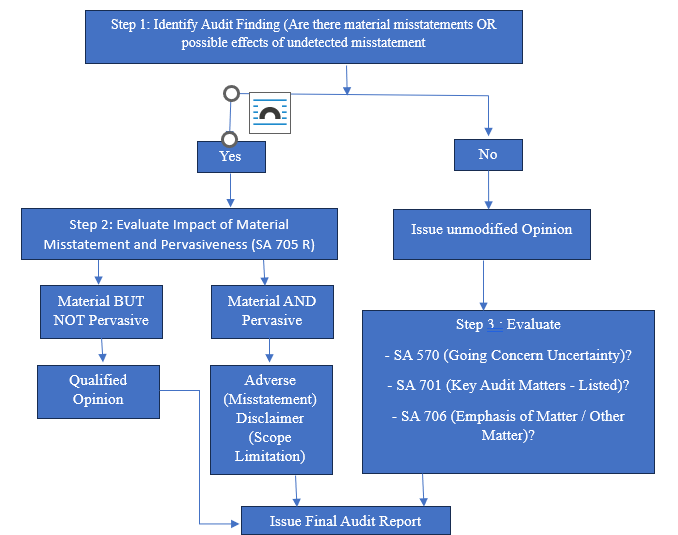
To ensure technical compliance and maintain a defensible audit trail, engagement teams should follow a three-step evaluation framework prior to signing any audit report as set out in following Flowchart :
19. Communication with Those Charged with Governance
Communication with those charged with governance (TCWG) is an integral part of the audit and reporting process. It facilitates effective oversight and provides a mechanism for communicating significant audit matters, including significant risks, key audit findings, significant auditor judgments and matters relevant to the auditor’s report.
Key Reporting Scenarios
Communication with TCWG is mandatory and particularly vital across several reporting standards:
- SA 705 (Revised) : circumstances giving rise to a modified opinion;
- SA 701 : matters determined to be Key Audit Matters;
- SA 706 (Revised) : matters proposed to be presented as an Emphasis of Matter or Other Matter; and
- SA 570 (Revised) : significant matters relating to going concern, including a material uncertainty related to going concern, where applicable.
Execution Requirements
- Timely & Detailed: Communication must occur at appropriate stages during the audit, be sufficiently detailed to enable meaningful dialogue, and be thoroughly documented in the audit working papers.
- Non-Delegable Responsibility: Discussions with TCWG do not replace or modify the auditor’s independent obligation to determine the correct reporting outcome under the SAs.
Regulatory Perspective: Documentation Linkage
Regulators require audit documentation to demonstrate an unbroken, clear linkage across three key stages:
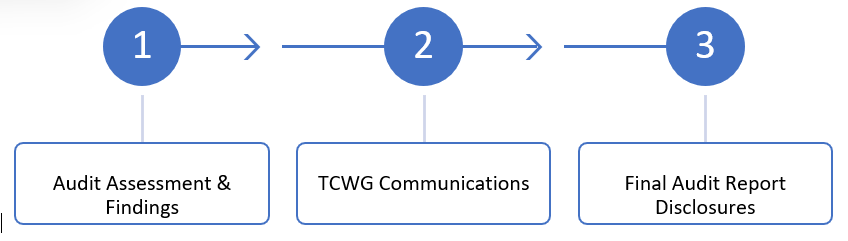
Core Lesson: TCWG engagement must function as a continuous, real-time element of audit execution, evaluation, and reporting never as a post-audit sign-off or checklist exercise.
20. Regulator Perspective – Lesson from NFRA and QRB
Regulatory observations demonstrate that auditor reporting deficiencies are often symptoms of weaknesses in audit evidence, professional judgment, documentation and application of the Standards, rather than merely drafting errors.
20.1. Lesson from NFRA Orders
The National Financial Reporting Authority (NFRA) is a statutory authority constituted under section 132 of the Companies Act, 2013, with responsibility for monitoring and enforcing compliance with accounting and auditing standards and overseeing the quality of professional services associated with such compliance. NFRA’s enforcement orders provide important insights into the application of the Standards on Auditing and, in particular, the exercise of professional judgment in auditor reporting.
This section considers selected findings of NFRA relating to SA 700 (Revised), SA 701, SA 705 (Revised), SA 706 (Revised) and SA 570 (Revised), with a particular focus on the preparation of the Independent Auditor’s Report and the interaction among the various reporting requirements.
20.1.1. NFRA, Order No. 023/2024 dated 10 October 2024 – Coffee Day Enterprises Limited
NFRA Findings
i. Inconsistency in the description of the auditor’s responsibilities
The auditors had expressed Disclaimer of Opinion on the standalone and consolidated financial statements on the basis of their inability to obtain sufficient appropriate audit evidence. However, the auditor’s reports stated, “We have audited…” and also contained language indicating that sufficient appropriate audit evidence had been obtained.
NFRA observed that, where an auditor disclaims an opinion due to an inability to obtain sufficient appropriate audit evidence, SA 705 (Revised) requires corresponding amendments to the description of the auditor’s responsibilities. The report should state that the auditor was “engaged to audit” the financial statements and explain that, because of the matters described in the Basis for Disclaimer of Opinion section, the auditor was unable to obtain sufficient appropriate audit evidence to provide a basis for an audit opinion. NFRA regarded the inconsistent wording as a significant deficiency in the auditor’s report.
ii. Key Audit Matters in a report containing a Disclaimer of Opinion
The auditors had included Key Audit Matters (KAMs) in the Independent Auditor’s Reports notwithstanding that they had disclaimed their opinion on the financial statements.
NFRA specifically referred to paragraph 29 of SA 705 (Revised), which provides that, unless required by law or regulation, where the auditor disclaims an opinion on the financial statements, the auditor’s report shall not include a Key Audit Matters section in accordance with SA 701.
The underlying rationale is important from a reporting perspective. Communication of KAMs in such circumstances could suggest to users that the financial statements are more credible in relation to those matters than would be appropriate when the auditor has been unable to obtain sufficient appropriate audit evidence to form an opinion on the financial statements as a whole
iii. Inappropriate use of Emphasis of Matter paragraphs
NFRA also noted that the auditors had included Emphasis of Matter (EOM) paragraphs in respect of matters that were neither presented nor disclosed in the financial statements. Under SA 706 (Revised), an EOM paragraph is intended to draw users’ attention to a matter appropriately presented or disclosed in the financial statements which, in the auditor’s judgment, is of such importance that it is fundamental to users’ understanding of the financial statements, subject to the other conditions prescribed by the Standard.
Accordingly, an EOM paragraph cannot be used as a general mechanism to highlight matters which the auditor considers significant or important but which do not satisfy the specific requirements of SA 706 (Revised). NFRA also noted the requirement to indicate, where an EOM paragraph is included, that the auditor’s opinion is not modified in respect of the matter emphasised
Key takeaway
The Order demonstrates that auditor reporting is not merely a matter of selecting the appropriate form of opinion. The drafting of the Independent Auditor’s Report must be internally consistent and must reflect the specific consequences prescribed by the applicable Standards. In particular, where a Disclaimer of Opinion is expressed, the auditor needs to consider the consequential requirements of SA 705 (Revised), including the restrictions on KAM and Other Information sections, the prescribed modification to the description of the auditor’s responsibilities, and the appropriate use of EOM paragraphs under SA 706 (Revised).
20.1.2. NFRA Order No. 62/2023 dated 22 November 2023
NFRA Findings
- Classification of the audit opinion
The auditor had qualified the opinion on the CFS on account of the Company’s non-consolidation of a subsidiary. NFRA observed that the impact of the non-consolidation was material and pervasive to the CFS, as the assets and liabilities of the subsidiary represented approximately 19.20% and 28.96%, respectively, of the consolidated assets and liabilities.
In view of the material and pervasive nature of the matter, NFRA held that a qualified opinion was not appropriate. In accordance with SA 705, Modifications to the Opinion in the Independent Auditor’s Report, the auditor was required to express an adverse opinion on the CFS.
Auditor’s admission
During the proceedings, the auditor acknowledged that, considering the material and pervasive effect of the non-consolidation of the subsidiary on the CFS, an adverse opinion ought to have been expressed instead of a qualified opinion.
Key takeaway
The Order underscores the importance of assessing the pervasiveness of a misstatement or limitation in scope, and not merely its materiality, when determining the appropriate form of modified opinion under SA 705. Where the effect is both material and pervasive, a qualified opinion is insufficient; an adverse opinion is required where the matter relates to a material misstatement of the financial statements.
ii. Non-consolidation: legal opinion does not replace auditor’s evaluation
The auditor relied on a legal opinion obtained by the Company concerning the pending proceedings before the Bombay High Court. However, NFRA noted that the audit file did not contain the relevant court order or the auditor’s evaluation of the legal opinion. NFRA further noted that there was no stay order prohibiting consolidation. Accordingly, the auditor’s reliance on the Company’s legal opinion did not provide a sufficient basis for not consolidating the subsidiary.
Professional takeaway
Reliance on management’s legal interpretation, without independent evaluation of the underlying legal position and its implications for financial reporting, may not constitute sufficient appropriate audit evidence.
20.1.3. NFRA Order No. 012/2024 dated 26 April 2024
NFRA examined the audit conducted by the statutory auditor appointed following the resignation of the predecessor auditor, who had reported suspected fraud in relation to loans aggregating approximately ₹7,900 crore under the General Purpose Corporate Loan (GPCL) portfolio.
NFRA Findings
i. Failure to appropriately evaluate matters reported by the predecessor auditor
The predecessor auditor had reported suspected fraud under Section 143(12) of the Companies Act, 2013, in relation to the GPCL portfolio and had raised concerns regarding, inter alia, the business rationale for the loans, internal controls over sanction and disbursement, monitoring of end-use, recoverability and existence of borrowers. The GPCL outstanding had increased substantially during FY 2018-19.
NFRA found that the incoming auditor did not obtain sufficient appropriate audit evidence or adequately examine the matters reported by the predecessor auditor. In particular, the audit file did not contain adequate documentation of the predecessor auditor’s report and underlying observations. Instead, the auditor relied substantially on information and explanations obtained from management.
NFRA also noted that the audit team had concluded at the client acceptance stage that there was no risk of material misstatement due to fraud, despite being aware of the predecessor auditor’s reporting under Section 143(12). NFRA considered this indicative of a lack of professional scepticism and inadequate identification and assessment of fraud risks under SA 240 and SA 315.
Professional takeaway: Where a predecessor auditor has reported matters involving suspected fraud or potentially material financial reporting implications, the incoming auditor should undertake a robust, independently documented evaluation of those matters rather than relying primarily on management’s explanations or conclusions
ii. Inadequate evaluation of going concern
The Company prepared its financial statements on a going concern basis. However, the audit file identified several events and conditions that could cast significant doubt on the Company’s ability to continue as a going concern, including a deterioration in credit ratings, a liquidity crunch and defaults in repayment of debt obligations, extension of maturities of non-convertible debentures, and non-recovery of GPCL amounts of ₹566.30 crore.
NFRA observed that the audit file did not contain sufficient appropriate audit evidence to support the auditor’s conclusion regarding the absence of material uncertainty relating to going concern. Further, the Company’s disclosures did not adequately describe the relevant events and conditions or the mitigating arrangements, including details concerning financing and refinancing arrangements.
NFRA specifically noted an inconsistency between the Company’s disclosures and the auditor’s Other Matter paragraph. While the auditor stated that the Company’s ability to meet its obligations was dependent on “material uncertain” events, the Company’s financial statements did not describe the relevant events as such. NFRA considered these inconsistencies, together with the absence of required audit procedures under SA 570, as demonstrating that the audit opinion lacked an adequate basis.
Professional takeaway: Identification of events and conditions that may cast significant doubt on going concern is only the starting point. The auditor is required to perform the further audit procedures necessary to evaluate management’s assessment, assess the adequacy of related disclosures and determine whether a material uncertainty exists.
iii. KAM disclosures did not correspond with the audit procedures actually performed
NFRA attached particular significance to the fact that ECL had been identified as a KAM, while the audit file did not demonstrate performance of the procedures described in the KAM.
The KAM referred, among other matters, to testing of internal controls over ECL. However, NFRA found that the relevant audit working papers did not contain evidence of such testing. The Order also noted deficiencies in the documentation, including references to earlier Accounting Standards rather than the applicable Ind AS framework.
Professional takeaway: A KAM is not merely a disclosure accompanying the audit report. The audit procedures described in relation to a KAM should be demonstrably supported by the audit file and should appropriately respond to the underlying significant audit risk.
iv. Modification of the audit opinion – failure to appropriately assess pervasiveness
The auditor issued a qualified opinion on the basis that sufficient appropriate audit evidence was not available to ascertain the recoverability of principal and interest, including the timeframe for recovery, in respect of overdue GPCL of ₹566.30 crore as at 31 March 2019. In this regard, the EP and the Audit Firm were charged with failure to consider the pervasiveness of GPCL transactions and balances while forming the audit opinion.
Pervasiveness extended across multiple financial statement elements
NFRA noted that the auditor’s overall materiality was ₹15.34 crore, whereas the principal and interest overdue amounts were substantially above that threshold.
Given the absence of sufficient evidence regarding recoverability, NFRA found that the assertions relating to:
- valuation of loans of at least ₹945.58 crore;
- accuracy of interest outstanding of approximately ₹12 crore; and
- accuracy of ECL of at least ₹107 crore
remain unverified.
NFRA further observed that the affected assertions had implications for total income, total expenditure, net profit, earnings per share, total assets, total liabilities, net worth and the notes to accounts. Accordingly, the matter was not confined to a single element of the financial statements. NFRA concluded that the misstatements were pervasive for purposes of SA 705.
Despite this, the Audit Firm had concluded that the possible effects were “Material but Not Pervasive” and issued a qualified opinion.
NFRA concluded that, in the circumstances, the auditor was required to issue a disclaimer or adverse opinion, as applicable, under SA 330 read with SA 705 (Revised), rather than a qualified opinion.
Professional takeaway: The determination of the appropriate modified opinion requires an assessment not only of materiality but also of pervasiveness. Where the potential effects extend across multiple financial statement elements, the auditor should carefully evaluate whether the matter is truly confined to specific elements, accounts or disclosures.
20.2. Audit Reporting Under the QRB Lens
The Quality Review Board’s (“QRB”) audit quality reviews indicate that deficiencies in auditor reporting are not confined to matters of drafting or report presentation. In a number of instances, deficiencies in the auditor’s report were indicative of gaps in the underlying evaluation of audit evidence, application of professional judgement, documentation of conclusions and compliance with the applicable Standards on Auditing (“SAs”).
The observations assume particular significance because the auditor’s report is the culmination of the audit process. The reporting conclusion should therefore be traceable to the matters identified during the audit, the evidence obtained, the judgements exercised and the requirements of the applicable SA. The following observations are certain observations are particularly relevant to SA 700 (Revised), SA 701, SA 705 (Revised), SA 706 (Revised), SA 710, SA 720 (Revised) and SA 570 (Revised).
20.2.1. SA 700 Revised
- Failing to place the Opinion paragraph as the primary section at the start of the report.
- Omitting references to the Statement of Changes in Equity (SOCIE) in Ind AS financial reports, or omitting references to the Cash Flow Statement in statutory reporting sections.
- Incorrectly referencing a “loss” in the opinion text when the financial statements reflect a net profit, or omitting references to the notes to accounts.
- Incorrectly citing director remuneration provisions under Section 197 of the Companies Act, 2013 for private limited entities (to which the section does not apply)
- Use of the expression “qualified opinion” where the auditor’s opinion was not modified and there was no corresponding Basis for Qualified Opinion section.
- Issuance of the Independent Auditor’s Report using an outdated reporting format, rather than the applicable requirements of SA 700 (Revised).
- Independent Auditor’s Report was signed by a Partner other than the Engagement Partner where the Audit Firm was appointed as the auditor.
- Instances where the UDIN generated by the auditor related to a tax audit report under Section 44AB of the Income-tax Act, 1961, rather than the statutory audit report of the standalone financial statements.
20.2.2. SA 701
- Omitting the mandatory conclusion statement when the auditor determines there are no Key Audit Matters to communicate.
20.2.3. SA 705 Revised
- It was noted that although the auditor has qualified the report on matter related to (i) external confirmations, and (ii) compliance of AS 15, however, the qualification was not given in a manner as required by SA 705.
- The auditor did not modify the opinion despite the existence of inappropriate accounting policies having implications for the financial statements
20.2.4. SA 706 Revised
- Making incorrect reference, under the emphasis of matter paragraph, to a note that does not contain the relevant information on the matter being emphasised.
- Failure to include, in an Other Matter paragraph, the fact that reliance had been placed on the work performed by other auditors in respect of foreign branches, where such reporting was applicable.
- Failure to report, through an appropriate Other Matter paragraph, that the prior-period financial statements had been audited by a predecessor auditor, in circumstances where the requirements of SA 710 were applicable.
- Including an Emphasis of Matter relating to a judicial enquiry and imposition of penalty in the auditor’s report on consolidated financial statements, where the relevant matter was not appropriately disclosed in the consolidated financial statements and the auditor had not made clear whether the opinion was modified in respect of the matter
- Reporting, under the Key Audit Matters section, the fact that the financial statements of a wholly owned subsidiary and an associate had been audited by other auditors, rather than addressing the matter under the appropriate Other Matter reporting requirements.
20.2.5. SA 710
- Not reporting the fact, that prior period financial statements were audited by predecessor auditor, by giving ‘Other Matter Paragraph’ in Independent Auditor’s Report
20.2.6. SA 720 Revised
- It was observed that the auditor failed to detect the misstatement of fact in the Corporate Governance Report issued by the company. The company stated in the report that there had been no non- compliance of matters related to capital markets and thus no penalties in this regard; however, a notice of penalty or settlement charges was found to be received by the Company, and paid as settlement charges.
20.2.7. SA 570 (Revised)
- failure to document the auditor’s evaluation of management’s assessment of the entity’s ability to continue as a going concern;
- failure to obtain sufficient appropriate audit evidence to determine whether a material uncertainty existed, including inadequate consideration of management’s mitigating plans; and
- circumstances where material uncertainty existed, but the auditor did not appropriately evaluate the adequacy of the related disclosures and the resulting implications for the auditor’s report.
The auditor’s reporting conclusion should be supported by a clear, evidence-based exercise of professional judgement and appropriate documentation. Key practice considerations include:
- Document the assessment of pervasiveness: The audit documentation should clearly explain the basis for concluding whether the effects or possible effects of a matter are pervasive, including consideration of the affected financial statement elements and their significance to the financial statements as a whole.
- Evaluate disclosures before determining the reporting outcome: The auditor should assess the adequacy of the relevant financial statement disclosures before considering an EOM paragraph or a MURGC section. Where the disclosures are materially inadequate, the auditor should evaluate the need for a modified opinion under SA 705 (Revised).
- Do not use EOM as a substitute for modification: An EOM paragraph should not be used to draw attention to a matter that requires a qualified or adverse opinion.
- Exercise independent professional judgement: Management representations, legal opinions and other external advice may provide relevant audit evidence; however, they do not relieve the auditor of the responsibility to independently evaluate the accounting treatment, audit evidence and resulting reporting implications.
- Strengthen consultation and review for borderline cases. Where the distinction between a qualified opinion and an adverse opinion, or between a qualified opinion and a disclaimer of opinion, involves significant professional judgement, the engagement file should clearly document the alternatives considered, the basis for the conclusions reached, and the outcome of engagement quality reviews or technical consultations.
- Ensure compliance with report formatting requirements: The engagement partner should ensure that the auditor’s report complies with the applicable requirements of SA 700 (Revised), including the prescribed positioning of the Opinion and Basis for Opinion sections, appropriate headings and segregation of reporting under applicable laws and regulations.
Ultimately, the quality of an auditor’s report depends not only on identifying matters requiring reporting attention, but also on demonstrating a clear, consistent and supportable basis for the reporting conclusion, with appropriate linkage between the audit evidence, professional judgements and the requirements of the applicable Standards on Auditing.
22. Conclusion
22.1. Evidence Driven Opinion Formulation
Formulating an auditor’s opinion is fundamentally an exercise in professional judgment, not a mechanical drafting task. The signed audit report represents the technical culmination of an integrated audit lifecycle—encompassing the acquisition of sufficient appropriate audit evidence, the quantitative and qualitative evaluation of misstatements, a rigorous assessment of materiality and pervasiveness, and the precise application of auditing standards.
The most important practical insight is that these Standards operate sequentially and interactively. The auditor should first determine the opinion. Only after that should the engagement team complete the additional reporting analysis. A KAM cannot cure a qualification. An EOM paragraph cannot cure an inadequate disclosure. An Other Matter paragraph cannot cure a scope limitation. A going-concern paragraph cannot replace the modified opinion required when the going concern basis is inappropriate or when required disclosures are materially inadequate.
22.2. Integrity of the Reporting Hierarchy
The core framework of SA 705 (Revised) demands a structured, non-negotiable logic: identify the nature of the matter, evaluate its materiality, assess the pervasiveness of its actual or potential effects, and determine the precise form of opinion modification. Supplemental reporting mechanisms—such as Key Audit Matters under SA 701, Emphasis of Matter or Other Matter paragraphs under SA 706 (Revised), and Material Uncertainties under SA 570 (Revised)—address distinct communication objectives. They must never be deployed as a compromise or substitute for an opinion modification required by SA 705 (Revised).
22.3. Regulatory Defensibility and Audit Integrity
Regulatory oversight from bodies like NFRA and QRB reinforces a fundamental principle: the auditor’s report is the visible end-product of an underlying, documented chain of professional reasoning. The final reporting outcome must stand as the direct, defensible, and fully supported conclusion derived from the audit evidence in the working papers. Flaws in risk assessment, evidence gathering, professional skepticism, or documentation directly compromise the integrity of the signed opinion. For Auditor, the final question before signing should be simple. ‘Can we demonstrate, from the audit file, why this is the right opinion and why every additional reporting paragraph is both required and appropriately worded?’ If the answer is yes, the auditor’s report becomes not merely compliant, but credible, coherent and defensible.
[The author can be reached at tpmaru@yahoo.com.]