
Audit Documentation

From Basic Compliance to NFRA-Level Audit Evidence
“If it is not documented, it is not done” is the line every auditor learns early. But documentation isn’t uniform — what clears basic compliance may still fall short at Peer Review, and what survives Peer Review can still be tested hard by NFRA. This note maps the three levels and the documents each one expects.
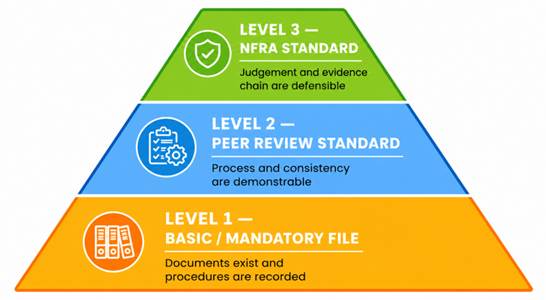
Level 1 — Basic / Mandatory File
The foundation, built on SA 230 and SQC 1/SQM. If any of this is missing, there isn’t an audit file — just signed financial statements.
| Area | Key Documents / Evidence |
| Engagement & Independence | · Engagement letter · Independence declaration (SA 220) · Client acceptance/continuance form · Communication with previous auditor |
| Planning | · Audit strategy & plan · Materiality workings · Risk assessment (SA 315) · Fraud risk discussion (SA 240) · Audit programme |
| Execution | · Lead & supporting schedules · Test of controls · Substantive testing papers · Third-party confirmations · Analytical review |
| Completion | · Management representation letter · CARO / Schedule III checklists · Sign-off checklist · Audit report & annexures |
Level 2 — Peer Review Standard
Peer Review asks a broader question: does the firm consistently follow a quality-driven process, not just reach the right answer once? A generic, template-driven file loses marks here even when the underlying work was sound.
| Area | Key Documents / Evidence |
| Firm-level QC | · SQC1/SQM policy document · Engagement monitoring records · Staff training & competency evidence |
| Risk & Materiality | · Entity-specific (not generic) risk assessment · Materiality basis & benchmark rationale |
| Sampling | · Population, methodology & coverage rationale · Treatment of individually significant items |
| Review Trail | · Preparer/reviewer sign-offs with dates · Review comments & their resolution · Partner consultation records |
| Governance | Time budget vs actuals · Client risk categorisation · Prior peer review report & action taken |
| The Stand-Alone File Test Hand the file to an independent, experienced auditor who was never on the engagement. Can they tell what the entity does, what the significant risks were, what was tested, what evidence was obtained, and why the opinion was appropriate — from the file alone? “The partner knows the background” is not documentation. If the file needs a person to explain it, the file itself is incomplete. |
Level 3 — NFRA Standard
NFRA behaves less like a checklist reviewer and more like a regulator building a case file. The test: can an independent inspector reconstruct the auditor’s thinking — risk, procedure, evidence, judgement — from the file alone, without anyone explaining it verbally?
| Area | Key Documents / Evidence |
| File Integrity | · Complete file incl. all versions/iterations · Audit trail of any post-signing changes · Documentation system / ERP logs |
| Governance & Independence | · Firm governance structure · Independence policy + engagement-level compliance evidence · Fee & non-audit-service disclosures |
| Judgement Trail | · Basis for estimates, impairment, going concern, revenue recognition · Evaluation of contrary evidence · Key Audit Matters rationale |
| Communication | · Correspondence with TCWG / audit committee · Engagement quality review working papers |
| Remediation | · Action taken on prior NFRA observations within prescribed timelines · Internal inspection records |
The chain every significant matter must show:
| RISK | PROCEDURE | EVIDENCE | CONCLUSION |
| Tick Mark vs. Thinking Audit — Inventory Example Weak file: “Physical verification report ✓ · Stock reconciliation ✓ · Valuation working ✓” — procedures happened, but nothing shows the auditor thought about the results. Stronger file: attendance strategy at each material location · treatment of slow-moving/obsolete stock · third-party and in-transit inventory · cut-off procedure · how physical-vs-book differences were resolved · NRV testing where relevant. |
The Three Levels, Side by Side
| Area | Level 1 – Basic | Level 2 – Peer Review | Level 3 – NFRA |
| Risk assessment | Standard risk list | Entity-specific & documented | Clearly linked to audit response |
| Materiality | Calculation available | Basis documented | Judgement & impact on procedures shown |
| Sampling | Sample selected | Methodology documented | Selection & coverage defensible |
| Review | Sign-off | Notes + resolution trail | Judgement & escalation clearly visible |
| Estimates | Management’s workings | Auditor’s review noted | Independent challenge + sensitivity |
| Conclusion | Short remark | Area-wise conclusion | Evidence-based professional judgement |
Five Habits That Hold Up Across All Three Levels
- Write it down as you decide it — documentation prepared after the audit is a reconstruction of memory, not a contemporaneous record.
- Make the file entity-specific — copy-pasted risk assessments and generic templates are the fastest way to lose credibility at Peer Review and NFRA both.
- Show the “why,” not just the “what” — a tick mark proves a step happened; a conclusion proves the auditor thought about the result.
- Keep the review trail visible — who prepared it, who reviewed it, when, what was raised, and how it was closed.
- Index and cross-reference properly — a file that can’t be navigated by an outsider is, for practical purposes, a file that wasn’t reviewed.
The Real Shift
Level 1 gets you compliant. Level 2 gets you a working quality system. Level 3 gets you a defensible professional judgement trail. The common thread: the further up you go, documentation stops recording what was done and starts justifying why it was done that way — and it has to be written down as the audit happens, not reconstructed afterward.
Area-Wise Documents Required — Base / Mandatory Audit Level
Level 1 (Base) documentation is not just a checklist of standard working papers — each financial statement line item carries its own set of supporting documents. This annexure breaks the “Execution” stage down by area, in the sequence a balance sheet is typically read.
Non-Current Assets
| Area | Documents / Working Papers Required |
| Property, Plant & Equipment (PPE) | · Fixed asset register/schedule reconciled with GL · Purchase invoices & board approval for major additions · Depreciation working (rate, method, useful life vs Schedule II) · Physical verification report & reconciliation · Title deeds for immovable property · Insurance policies · Utilisation certificate (for subsidy/grant-funded assets) · Capitalisation date & cost breakup · Disposal/sale approval, invoice & gain-loss working · Impairment assessment · CWIP ageing & status · Borrowing cost capitalisation working, if any · Revaluation report, if applicable |
| Intangible Assets | · Purchase agreement/licence · Amortisation working & useful life justification · Internally generated asset — R&D cost bifurcation (research vs development) · Impairment testing · Renewal/registration certificates (trademarks, patents) |
| Right-of-Use Assets (Ind AS 116) | · Lease agreements · Lease liability & ROU computation working · Discount rate basis · Lease modification/termination documents · Short-term/low-value exemption working |
| Investments | · Investment register/schedule · Contract notes / purchase-sale confirmations · Demat statement / physical certificates · Board resolution for investment/divestment · Fair valuation working / NAV statements · Impairment testing (subsidiaries, associates, JVs) · Classification working (FVTPL/FVOCI/amortised cost) · Confirmation from investee companies |
Working Capital — Assets & Liabilities
| Area | Documents / Working Papers Required |
| Inventory | · Stock registers / perpetual records · Physical verification report with reconciliation · Valuation working (method used vs NRV comparison) · Stock ageing report · Slow-moving/obsolete provision working · Goods-in-transit & consignment stock details · Third-party warehouse confirmations · Cut-off evidence (GRN/dispatch near year-end) · Costing records/cost sheets |
| Trade Receivables | · Debtors ageing schedule · Balance confirmation letters (positive/negative) · Bad debts / ECL provision working · Subsequent receipts evidence · Post year-end credit notes · Sales invoices/contracts supporting balances · Related-party receivable confirmations · Litigation/dispute status, if any |
| Trade Payables | · Creditors ageing schedule · Balance confirmation letters · Purchase invoice-GRN matching · MSME identification & disclosure working · Subsequent payment evidence · Post year-end debit notes · Related-party payable confirmations |
| Loans & Borrowings | · Loan agreements / sanction letters · Bank statements · Repayment schedule · Interest computation / EMI schedule · Security & charge documents (CHG-1/CHG-4 filings) · Lender confirmation letters · Covenant compliance certificates · Current/non-current classification working |
Cash, Revenue & Operating Expenses
| Area | Documents / Working Papers Required |
| Cash & Bank Balances | · Bank statements for the year · Bank reconciliation statements · Bank balance confirmation certificates · Physical cash verification certificate · Fixed deposit receipts/confirmations · Cheques on hand/in transit · Restricted or earmarked balance details (unpaid dividend, escrow, margin money) |
| Revenue | · Sales register · Sample invoices/contracts · Revenue recognition policy working · Cut-off testing evidence · Discounts/rebates/credit notes working · Contract asset-liability reconciliation · Variable consideration working · Related-party sales details |
| Employee Benefit Expenses | · Payroll register/summary · Headcount reconciliation · Actuarial valuation report (gratuity, leave encashment) · PF/ESI/PT statutory challans · Bonus & incentive working · KMP remuneration & Schedule V compliance · ESOP valuation working, if applicable |
| Finance Costs | · Loan/lease statements · Interest computation working · Bank charges & processing fee details · Borrowing cost capitalisation working · Lease interest working |
Other Income, Tax, Provisions & Equity
| Area | Documents / Working Papers Required |
| Other Income | · Interest income working with FD interest certificates · Dividend receipt evidence · Rental income agreements · Profit on sale of assets/investments working · Vouching of miscellaneous/other income items |
| Taxation (Direct & Indirect) | · Income tax computation & return · Advance tax challans · TDS reconciliation with Form 26AS · Deferred tax working · Assessment orders/notices, if any · GST returns & reconciliation with books · Tax audit report (Form 3CD) |
| Provisions | · Basis of estimation / working note · Board approval for material provisions · Legal opinion, where obtained · Movement schedule — opening, addition, utilisation, closing · Warranty provision working · Actuarial reports, where relevant |
| Contingent Liabilities & Commitments | · Status summary of litigation from management/legal team · External lawyer confirmation letters · Bank guarantee / letter of credit details · Corporate guarantee details · Show-cause notices / demand orders · Management’s probability assessment (probable/possible/remote) |
| Share Capital & Reserves | · ROC filings (MGT-7, PAS-3) · Share certificates / allotment records · Board & shareholder resolutions · Reserves movement schedule · Bonus/rights issue/buyback documents, if any |
| Related Party Transactions | List of related parties identified (Section 2(76) / Ind AS 24) · RPT register · Board/Audit Committee approvals (Section 188) · Agreements with related parties · Arm’s-length pricing justification |
Note: This list is indicative of the minimum base-level evidence. The objective is a working paper for every line item that can independently answer the risk → procedure → evidence → conclusion chain.
[The author can be reached at priten@shahvalera.in.]