
SUCCESS STORIES – DR. CA RAJESH CHHEDA
From a 150-Sq-Ft Room to Empowering 8 Lakh+ Students: Story of Startup to Success
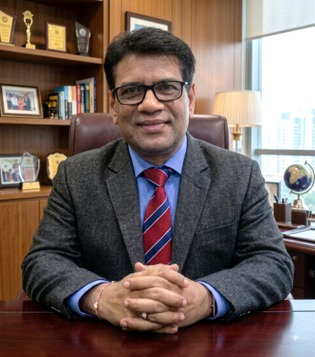
About Dr. CA Rajesh Umarshi Chheda
Dr. CA Rajesh Umarshi Chheda is a distinguished Chartered Accountant, Certified Public Accountant (USA), and Ph.D. He serves as the Chairman and Managing Director of Raj Software Technology (India) Ltd., which operates India’s leading computer training brand, Raj Computers Academy. A passionate researcher and educator, he is also the author of three published books on technology management, vocational accounting, and entrepreneurial leadership.
Q. If you had to describe your journey in one line, what would it say?
A qualification is a foundation, not a ceiling; I used my CA not to search for a secure job, but to build a scalable and sustainable enterprise in the field of computer and skill training.
Q. What motivated you to choose entrepreneurship immediately after qualifying as a Chartered Accountant?
During my college days, most commerce graduates aspired to climb the traditional corporate ladder. I wanted to build something from scratch that could outgrow its founder. The CA curriculum gave me the bedrock of business logic, financial acumen, and risk management. Instead of viewing the degree as a final destination, I treated it as the toolkit needed to launch and run an enterprise with financial discipline from day one.
Q. How did the journey begin, and what was your first real break?
In 1996, I started with a first computer training centre at malad west , mumbai. In a tiny 150 sq. ft. room.At that time, Indian businesses were transitioning to computerized accounting, but there was a massive shortage of practical skill training. Spotting this gap early, I launched India’s first Tally Academy to provide hands-on vocational accounting education.
Between 1996 and 2000, we bootstrapped and grew from 1 to 13 centers. That early phase taught me a foundational business lesson: before you dream of scaling, you must master the unit economics of a single centre and build a standardized operational playbook.
Q. In 2000, you took a path rarely seen in traditional training institutes by bringing in large corporate backing. How did that happen?
That was our “Shark Tank” moment long before the term became popular. In 2000, we converted our proprietary firm into a closely held public limited company and secured strategic equity investment from the reputed industry Group.
Strategic capital is never just about money; it brings governance, operational maturity, and a clear roadmap for expansion. we transitioned from a capital-heavy model of company-owned centres to an empowered franchisee ecosystem. This enabled rapid, win-win expansion while maintaining strict, centralized quality control. Crucially, throughout this expansion, we remained a consistently profitable, dividend-paying company rather than chasing cash-burning growth.
Q. Seventeen years later, you executed a 100% equity buyback. What drove that decision?
Equity is the most valuable asset you will ever own. You should know when to share it to unlock scale, but you must also know when to bring it back home. After 17 highly successful and profitable years of partnership with the Group done buy back 100% of the equity in 2017. We returned to full ownership while retaining the governance standards and scale we had developed over nearly two decades.
Q. How did the business evolve to embrace social impact and national policy?
Enterprises cannot operate in isolation; they must align with the nation’s growth. In 2014, when the Government of India launched the Skill India Mission, we established a dedicated Skill Development Division. We became an official training partner with the NSDC and created a tangible impact in vocational education across the country.
We leveraged corporate CSR partnerships with organizations like the Hero Group, IPCA Laboratories, and several other reputed companies to provide free, high-quality vocational training to underprivileged youth. This opened doors to contributing at a systemic level, leading to our appointment as an industry representative on the Skill India Implementation Committee under the Ministry of Skill Development and Entrepreneurship.
Q. How do your distinct brands drive this dual mission of commercial IT training and grassroots skilling?
We deliver this through two dedicated brand vehicles. Our flagship computer training brand, Raj Computers Academy, operates 154 training centres across four states and has trained over 8 lakh students in practical IT and accounting skills. Complementing this, our specialized entity—the Skill Development and Vocational Training Institute of India—drives our social impact and CSR initiatives, having provided completely free, employment-linked skill training in the banking and retail sectors to more than 20,000 underprivileged youth.
Q. Tell us about your feature on Doordarshan.
In 2019, Doordarshan featured our work on its flagship program Hunarbaaz. The show highlighted our initiatives to provide employment-centric skill training to the poorest of the poor and facilitate placements in the organized sector. The televised feature and interview received widespread appreciation across India.
Q. You completed a CPA (USA) and two Ph.D.s while managing a growing company, alongside receiving prestigious awards in education. Why pursue continuous academic learning?
An enterprise can only grow as fast as its leader. The CA provided a strong financial foundation, the CPA expanded my global financial outlook, and my doctoral research allowed me to synthesize academic frameworks with three decades of practical execution. I was honored to receive the prestigious Outstanding Research Contribution Award (ORCA) from the University of Mumbai and the Young Achiever in Education Award from the Maharashtra Business Training Board. Additionally, traveling to over 20 countries helped me incorporate global vocational benchmarks into our Indian training models. Lifelong learning is not an ornament—it is an operational necessity.
Q. Beyond academic research, you have also authored three books. How do they connect your entrepreneurial experience with practical learning?
Writing allows me to translate field-tested experience into structured knowledge. Each book addresses a critical dimension of our work:
- Management Strategies for IT Companies: Focuses on operational frameworks, scalability, and strategic management for tech enterprises.
- Learn TallyPrime: Serves as a hands-on, vocational guide to bridge the gap between classroom accounting and computerized industry execution.
- From Startup to Success: Outlines an actionable entrepreneurial roadmap for building resilient, profitable, and sustainable ventures.
Knowledge compounds when shared, and authoring these works is an extension of our mission to educate and empower aspiring professionals and entrepreneurs.
Q. Is your company also involved in implementing CSR initiatives for BSE and NSE?
Yes. I am proud to share that our company is empanelled by SEBI for financial literacy. Under this mandate, we collaborate with both BSE and NSE to conduct nationwide investor awareness programs and deliver financial literacy sessions as part of their CSR initiatives.
Q. What are the core pillars behind building a sustainable enterprise?
I summarize enterprise building into five enduring pillars:
- Clear Idea: Identifying and solving an unaddressed market problem.
- Vision: Looking beyond short-term quarterly gains toward a 10-year horizon.
- Hard Work: Embracing unglamorous day-to-day operational execution.
- Strategic Management: Structuring scalable partnerships and protecting unit economics.
- Integrity: Building unshakeable trust across decades.
Q. If you had to share a few guiding thoughts for young Chartered Accountants, what would they be?
- Integrity is your highest valuation: Technologies evolve, economic cycles shift, and markets fluctuate, but trust is the only asset that compounds over 25+ years. It is the reason partners invest, corporates allocate CSR funds, and students trust your institution.
- Protect the bottom line first: Valuation is vanity; cash flow and profitability are sanity. Master your unit economics before attempting to scale.
- Pivot without losing your core mission: We started with basic accounting software training and evolved into a multi-disciplinary tech and skill development engine. Our programs evolved with time, but our core mission—empowering youth through sustainable livelihoods—remained unchanged.
- Redefine your ROI: Return on Investment is not just the profit on your balance sheet. The ultimate ROI lies in the careers you launch, the families you uplift, and the ecosystem you leave behind.