
Foreign Asset of Small Taxpayer – Disclosure Scheme 2026
A One-time Foreign Asset Disclosure Compliance Window under Chapter IV (Sections 130 to 144) of the Finance Act 2026 read with the Foreign Assets of Small Taxpayers – Disclosure Scheme Rules, 2026


Background and Introduction
The Black Money (Undisclosed Foreign Income and Assets) and Imposition of Tax Act, 2015 (Black Money Act) was enacted with the objective of curbing the concealment of undisclosed foreign income and assets by taxpayers. However, the same is accompanied by stringent tax, penalty and prosecution provisions. The Black Money Act has imposed severe consequences for non-disclosure of foreign income and foreign assets. Undisclosed foreign income and assets are charged to tax at 30%, with a penalty of up to 300% of that tax (effectively 90% of the asset value). Further, a failure to furnish a return of income, or the furnishing of inaccurate particulars of a foreign asset in the return, attracts a flat penalty of ₹10 lakhs. In addition to the penalties, wilful evasion attracts rigorous imprisonment of three to ten years.
Global transparency frameworks such as the Automatic Exchange of Information (AEOI) and the Common Reporting Standard (CRS) have made it virtually impossible to keep foreign income or holdings hidden. Recognising the gap between harsh penalties and inadvertent defaults, the Government has introduced FAST-DS 2026 against the backdrop of recurring inadvertent non-disclosure of foreign assets and foreign-source income, typically by individuals with modest overseas holdings – returning NRIs / Overseas Citizens of India (OCIs); salaried employees holding ESOPs/ESPPs/RSUs from a foreign employer that were taxed as salary or perquisites but not reported in Schedule FA, persons retaining dormant or low-balance accounts opened during overseas studies and more. The significance of FAST-DS lies in the distinction it draws between tax non-compliance and reporting non-compliance – a distinction that governs eligibility, the cost of declaration and the extent of immunity available.
Filing Window
| Date of Commencement of Scheme | 16th August 2026 |
| Last date of Scheme | 31st December 2026 |
Eligible Assessee as per Section 131
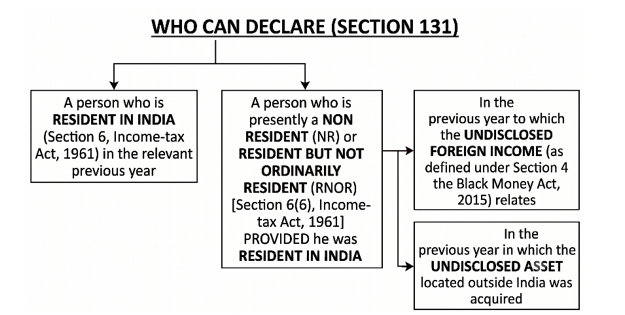
1. Note: What matters under the second limb is the residential status in the previous year in which the foreign income arose or the foreign asset was acquired. The second limb eligibility specifically applies to individuals who are currently Non-Residents (NR) or Resident but Not Ordinarily Resident (RNOR). Accordingly, being an NR or RNOR at present is not a disqualification rather it is a qualifying condition under this limb, provided taxpayer was resident in the previous year in which the undisclosed income arose or foreign asset was acquired.
2. Examples:
i. Ms. Shah acquired foreign asset worth ₹25 lakh from tax paid salary savings while being resident in India and later moved overseas and became non-resident. While she correctly reported salary to tax but missed to disclose foreign asset in Schedule FA. Under the Scheme, she is eligible to regularise this omission by declaring the investment in the foreign asset, provided she meets the prescribed conditions and is not disqualified.
ii. Mr. Jain worked in the United States from 2018 to 2024 and was a non-resident of India. During this period, he acquired US equity shares and bank savings from his earnings. He returned to India in 2025 and became resident. On becoming a resident, he has to disclose all foreign assets held by him and foreign sourced income earned after being a resident. Under the Scheme, he is eligible to regularise this by declaring undisclosed foreign holdings and income, provided he meets the prescribed conditions and is not disqualified.
Previous Years for which Declaration can be made (Section 132)
A person may file a declaration for any previous year, where:
- he has failed to furnish a return under Section 139 of the Income-tax Act, 1961 or
- he has failed to disclose such asset or income in a return of income furnished by him under the Income-tax Act, 1961 before the date of commencement of this Scheme or
- such asset or income has escaped assessment under Section 147 of the Income-tax Act, 1961.
Amount Payable by Declarant (Section 133)
Section 133 recognises two distinct scenarios, for which declaration may be filed in Form 1. The amount payable under the scheme varies for each scenario.
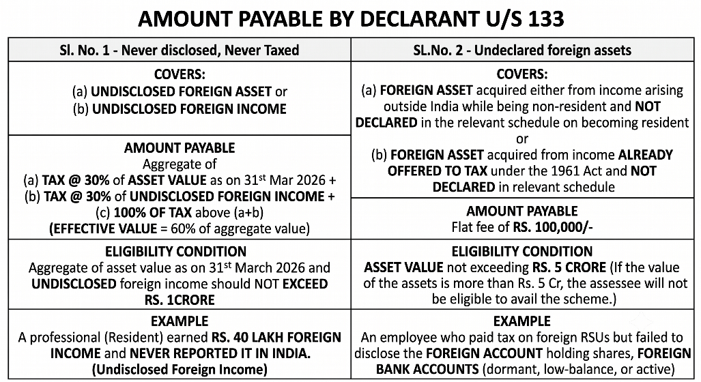
1. Note:
- Undisclosed asset located outside India means an asset (including financial interest in any entity) located outside India, held by the assessee in his own name or in respect of which he is a beneficial owner and he has no explanation about the source of investment in such asset or the explanation given by him in the opinion of the Assessing Officer is unsatisfactory.
Here the beneficial-ownership limb matters – an asset held even through a nominee, a trust, or an entity is not outside this ambit merely because the taxpayer’s name is not on it - Undisclosed foreign income means the total amount of income of an assessee from a source located outside India which was chargeable to tax in India but has not been offered to tax under the Income-tax Act, 1961.
- The ₹1 crore ceiling under Sl No 1 is an aggregate of what is actually being declared. Where both an undisclosed asset and undisclosed income are declared, it is the asset value and the income taken together, not each tested separately.
- Valuation date for Undisclosed Assets shall be 31.03.2026 and shall be valued as per Valuation Rules mentioned later.
2. Examples of Sl. No. 1 – Never Disclosed and Never Taxed Income and Assets
| Sr No | Nature of Undisclosed Item(s) | Aggregate Declared Value | Eligibility Status | Tax @ 30% | Additional Amount (100% of Tax) | Total Amount Payable |
| 1 | • Foreign Bank Account acquired in FY 21-22: ₹55 Lakh (value as on 31.03.2026) • Foreign Income: ₹25 Lakh (Asset+Income) | ₹80 Lakh | Eligible (does not exceed ₹1 crore) | • Tax on Value of Asset: ₹16.50 Lakh • Tax on Income: ₹7.50 Lakh Total Tax = ₹24 Lakh | ₹24 Lakh | ₹48 Lakh |
| 2 | • Foreign Property inherited in FY 12-13: ₹90 Lakh (value as on 31.03.2026) • Foreign Income: ₹30 Lakh (Asset+Income) | ₹1.2 Crore | Not eligible (exceeds ₹1 crore) | – | – | Scheme benefit not available |
| 3 | • Foreign Income earned in FY 2017-18: ₹40 Lakh • Foreign Income earned in FY 2020-21: ₹50 Lakh (Income+Income) | ₹90 Lakh | Eligible (does not exceed ₹1 crore) | • Tax on Income 1: ₹12 Lakh • Tax on Income 2: ₹15 Lakh Total Tax = ₹27 Lakh | ₹27 Lakh | ₹54 Lakh |
| 4 | • Foreign Income earned in FY 2016-17: ₹70 Lakh • Foreign Income earned in FY 2019-20: ₹80 Lakh (Income+Income) | ₹1.5 crore | Not eligible (exceeds ₹1 crore) | – | – | Scheme benefit not available |
3. Examples of Sl. No. 2 – Asset acquired from foreign sourced income when assessee was a Non-Resident or Asset acquired from Income Taxed in India but not declared in FA Schedule
| Sr. No | Nature of Item(s) | Aggregate Value | Eligibility | Fees payable under Scheme |
| 1 | • Foreign mutual fund acquired in FY 2020-21: ₹2 Crore (value on 31.03.2026) • Foreign shares acquired in FY 2022-23: ₹2.5 Crore (value on 31.03.2026) | ₹4.5 crore | Eligible (as does not it exceeds ₹5 crore) | Flat fees: ₹1 Lakh |
| 2 | • Foreign immovable property acquired in FY 2018-19: ₹3 Crore (value on 31.03.2026) • Foreign securities acquired in FY 2021-22: ₹3.5 Crore (value on 31.03.2026) | ₹6.5 crore | Not eligible (as it exceeds ₹5 crore) | Scheme benefit not available |
Validity of Declaration (Section 134(3))
The declaration made in Form 1 shall be deemed to be invalid if:
(a) any material particular furnished in the declaration is found to be false at any stage or
(b) the declarant violates any of the conditions referred to in this Scheme.
Where the Scheme Does NOT Apply (Section 140)
- income or assets representing, directly or indirectly, proceeds of crime where proceedings have been initiated or are pending under the Prevention of Money-laundering Act, 2002; or
- income or assets relating to an assessment year for which assessment proceedings under the Black Money Act have been completed.
Effect of Declaration on Assessment and Finality of Completed Assessments
a. Once an assessee makes a valid declaration in Form 1 and pays the amount prescribed in Form2 within the permitted time (including extended period), he is granted immunity from any further tax, penalty and prosecution under the Black Money Act in respect of the undisclosed foreign income or asset covered in Form 1, for the year ended 31st March 2026 or any prior years. (Section 139).
b. Also, the amount of income or asset declared shall not be assessed by including the same in the total income of the declarant for any assessment years under the Income Tax Act 1961 or under the Black Money Act (Section 136).
c. No amount paid (tax/interest/fee/penalty) under the Scheme is refundable (Section 138).
d. Where declaration of any income or asset is made under the scheme and any amount is paid on it, the declarant cannot claim rectification or revision of any assessment under the 1961 Act or the Black Money Act in respect of what is declared and cannot claim any set-off or relief in any appeal, reference or other proceeding relating to such an assessment (Section 137).
e. Where a declaration of any income or asset is made under this scheme and assessment proceedings under the Income-tax Act, 1961 or the Black Money Act, 2015 are pending in respect of such income or assets, the Assessing Officer shall take such declaration into account while finalising such assessment order.
In other words – a completed Black Money Act assessment bars a declaration under the Scheme but a pending proceeding does not (Section 141).
Valuation of Different Types of Assets (Rule 3)
Value of the asset means the fair market value (FMV) of the asset as on 31.03.2026, determined in the manner prescribed under Rule 3. The general rule across categories: FMV is the higher of (i) cost of acquisition, and (ii) market value as on 31.03.2026. Wherever a formal market valuation is not obtained, indexed cost of acquisition automatically becomes the deemed FMV.
| Asset Category | FMV — Rule 3(1) | Form 1(Annexure) fields to furnish |
| Bullion, jewellery, precious stones | Higher of – cost of acquisition or – open-market price as on 31.03.2026 per a report from a valuer recognised by the government of a country or specified territory outside India (or its agency); or indexed cost of acquisition where valuation is not carried out | Jewellery (attach valuation report, if applicable) Gold, by purity, weight and value (repeat per lot) Diamonds of 1 carat or more, by carat, cut, colour and clarity, with country of purchase Diamonds below 1 carat and other stones, by value Other precious metals, by value Common information – Country of purchase, date of acquisition, total acquisition cost, indexed cost of acquisition, valuer’s estimate, if applicable, FMV as per Rule 3 to be furnished in Form 1 |
| Artistic work (paintings, sculptures, archaeological collections, drawings, etc.) | Same basis as above | Artistic work (attach valuation report, if applicable): nature of the artistic work; country of location; name(s) under which held; date of acquisition; cost of acquisition; indexed cost of acquisition; valuer’s estimate, if applicable; FMV as per Rule 3 to be furnished in Form 1 |
| Quoted shares & securities | Higher of –cost of acquisition or –average of lowest/highest price on an established securities market on 31.03.2026 (or immediately preceding trading date) | Quoted shares and securities: Description of the security or share, name of issuer, number and type; established securities market where quoted; country where that market is located; name(s) under which held; cost of acquisition; date(s) of acquisition; value determined under Rule; date of valuation; FMV as per Rule 3. |
| Unquoted equity shares | Higher of –cost of acquisition or –formula value: [(A+B−L)×PV]/PE; or indexed cost of acquisition where valuation is not carried out. [A = book value of assets (excl. bullion, jewellery, artistic work, shares, property; less tax paid net of refund and unamortised deferred expenditure); B = FMV of bullion, jewellery, shares, artistic work and immovable property; L = book value of liabilities (excl. paid up equity capital, reserves, tax provisions net of refund claims, contingent /unascertained liabilities); PE = paid-up equity capital; PV = paid-up value of the shares] | Unquoted equity share – Attach valuation report, if applicable): description of the share, being name of issuer, number and type; country of location; name(s) under which held; date(s) of acquisition; cost of acquisition; indexed cost of acquisition; value determined under Rule 3, if applicable; date of valuation; FMV as per Rule 3. |
| Unquoted shares/securities (non-equity) | Higher of: –cost of acquisition or –open-market price as on 31.03.2026 per a report from a valuer recognised by the government of the country or specified territory outside India (or its agency); or indexed cost of acquisition where valuation is not carried out | Unquoted shares and securities other than equity shares – Attach valuation report, if applicable: description of the security or share, being name of issuer, number and type; country of location; name(s) under which held; date(s) of acquisition; cost(s) of acquisition; indexed cost of acquisition; value determined under Rule 3, if applicable; date of valuation; FMV as per Rule 3. |
| Immovable property | Higher of: – cost of acquisition or – open-market price as on 31.03.2026 per a report from a valuer recognised by the government of the country or specified territory where the property is situated (or its agency); or indexed cost of acquisition where valuation is not carried out | Immovable property – Attach valuation report, if applicable: nature of the property, being land, building, flat or the like; address of the property; country of location; name(s) under which held; date of acquisition; total acquisition cost; indexed cost of acquisition; value estimated by the valuer on the valuation date, if applicable; FMV as per Rule 3. |
| Bank account | – Sum of all deposits from account-opening date to 31.03.2026; or – if account was earlier declared under Chapter VI of the Black Money Act and subjected to tax and penalty, sum of all deposits since that declaration date – Any deposits made out of withdrawals from the account shall be excluded | Bank account: name and address of the bank; country of location; account holder name(s); account number; account opening date; sum of all credits in the account; FMV as per Rule 3, with a separate computation where it differs from the sum of credits. Note the divergence in wording: Rule 3(1)(e) values the account on deposits, while Form 1 calls for the sum of credits. |
| Interest in firm / AOP / LLP | Net-asset method: (i) net assets = A+B−L (as defined above); (ii) capital portion allocated per capital-contribution ratio; (iii) residue allocated per partnership deed or agreement for distribution of assets in the event of dissolution, else profit-sharing ratio | Any other asset: Attach valuation report, if applicable. Form 1 has no dedicated head for an interest in a firm, AOP or LLP, so it is furnished here: description of the asset; country of location; name(s) under which held; date(s) of acquisition; cost(s) of acquisition; indexed cost of acquisition; value determined under Rule 3(1), if applicable; date of valuation; FMV as per Rule 3. |
1.Note:
a. Where an asset was transferred before 31.03.2026, its FMV is the higher of cost of acquisition and actual sale price (or if transferred without consideration/for inadequate consideration, then higher of cost and FMV on the date of transfer).
b. Where sale proceeds were reinvested in a new asset, the FMV of the old asset/bank account is reduced by the amount reinvested, to avoid double counting.
c. For bullion, jewellery, precious stones, artistic work and unquoted non-equity securities, the valuer may be one recognised by the government of any country or specified territory outside India, or any of its agencies — not necessarily the country of acquisition. For immovable property, the valuer must be recognised by the government of the country in which the property is located
d. Currency conversion: For RBI-designated permitted currencies, use the RBI reference rate as on 31.03.2026 or the valuation date. Where the currency is not an RBI-designated permitted currency, first convert to US Dollars at the rate as the valuation date specified by the central bank (or, failing that, another regulated bank) of the country/jurisdiction where the asset is located and then convert the USD value to INR at the RBI reference rate as on 31.03.2026 or the valuation date.
e. 20% tolerance band: For assets other than a bank account, where the FMV declared in Form 1 is later found by an Assessing Officer (or other income-tax authority), during assessment or inquiry, to differ from the value the authority determines, the declaration will NOT, for that reason alone, be treated as invalid or void on the ground of misrepresentation, suppression of facts or furnishing false material particulars provided the variance does not exceed 20% of the FMV so declared.
2.Examples of Valuation of Different Asset:
1. Quoted Shares
Client acquired US-listed shares for $10,000 (₹6 lakh equivalent then); on 31.03.2026 the average of day’s high/low works out to ₹9.5 lakh → FMV = ₹9.5 lakh (higher of the two).
2. Unquoted Shares
Client acquired 1,000 unquoted equity shares on 15.06.2021 in GlobalTech Inc. (US-based private company) for $ 10,000/- (₹750,000 equivalent then). Valuation as on 31st March 2026 (Foreign Currency) from the audited balance sheet of GlobalTech Inc. as on 31st March 2026 is as follows:
| Book Value of Total Assets (A) = $ 2,000,000 |
| Total Outside Liabilities (L) = $ 800,000 |
| Net Asset Value (A – L) = $ 1,200,000 |
| Total Paid Up Equity Share Capital (PE) = $ 50,000 |
| FMV per share = [(A+B−L) ×PV]/PE = ($1,200,000 × $1)/$50,000 = $24 per share (assuming B = Nil and paid-up value PV = $1 per share) |
| Total FMV of 1000 shares (1,000 × $24) = $ 24,000 |
| RBI Reference Rate (31.03.2026) = ₹85 per USD |
| FMV in INR: $ 24,000 * 85 = ₹20,40,000 |
Therefore FMV = Higher of (₹7,50,000 or ₹20,40,000) = ₹20,40,000
3. Immovable Property Abroad and Bank Account
Deepak, aged 45 (an Indian citizen) has settled in California, USA since 2018. Prior to that, he has always been in India. He had acquired a residential property in California on 25.06.2009 for USD 20,000. He kept bank deposit of USD 10,000 in a bank account in New York since 15.04.2010. The fair market value of residential property as on 31.03.2026 was USD 25,000. Note: The exchange rate of Indian currency per 1 USD as per the reference rate of the RBI on the various dates are: 31.03.2026 = ₹71/$, Is Deepak eligible to apply for FAST-DS? If yes, compute the value of undisclosed foreign asset chargeable to tax in the hands of Deepak for FAST-DS 2026.
Answer: In this Scheme “assessee” includes a person being a non-resident in India within the meaning Income Tax Act in the previous year, who was resident in India either – In the previous year to which the income relates or in the previous year in which the undisclosed asset located outside India was acquired. Hence Deepak will be eligible.
| Particulars | USD | ₹ |
| Value of residential property in California acquired on 25.6.2009 | ||
| Higher of – | ||
| Cost of Acquisition | 20,000 | |
| open-market price as on 31.03.2026 per a valuer recognised by the government of the country where the property is situated | 25,000 | |
| Converted into Indian currency taking the rate as on 31.03.26 | ₹71/USD | 17,75,000 |
| Bank Deposits in a bank A/c in New York as on 31.03.2026 [The sum of all the deposits made in the account with the bank since the date of opening of the account would be the value of the bank deposits] | 10,000 | |
| Converted into Indian currency taking the rate as on 31.03.2026 | ₹71/USD | 7,10,000 |
| Total value of undisclosed foreign asset | 24,85,000 |
Procedural Roadmap
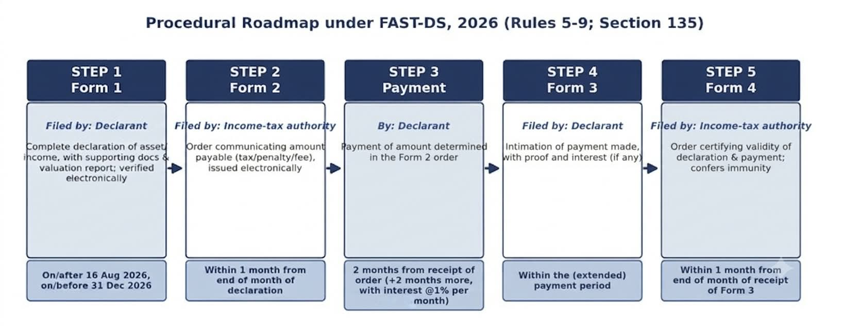
Example:
| Particulars | Amount | ||
| Undisclosed Asset and Income Valuation | • Undisclosed Foreign Bank Account (as on 31.03.2026) • Undisclosed Foreign Income (earlier previous years) | ₹60,00,000 ₹20,00,000 | Aggregate Value: ₹80,00,000 (Within Table 1 limit of ₹1 Crore) |
| Tax Computation | • Tax @ 30% on Value of Undisclosed Foreign Asset (₹60 Lakh * 30%) • Tax @ 30% on Undisclosed Foreign Income (₹20 Lakh * 30%) | ₹18,00,000 ₹6,00,000 | Total Tax: ₹24,00,000 |
| Total Scheme liability = Tax computed above + Additional Amount (100% of Tax) | ₹24,00,000 + 100% on ₹24,00,000 | ₹24,00,000 + ₹24,00,000 | Total Scheme Liability: ₹48,00,000 |
| Order Details | Order passed in Form 2 | – | Date of Order: 22.09.2026 |
| Payment Scenario A (No Interest) Payment made on 25.11.2026 | Payment made on or before 30.11.2026 (within 2 months from end of order month 30.09.2026) | ₹48,00,000 | Reported in Form 3 with ₹0 Interest |
| Payment Scenario B (With Interest) Payment made on 17.12.2026 | Delay = 1 month (or part thereof) beyond 30.11.2026. Interest = 1% of ₹48 lakh = ₹48,000. | • Base: ₹48,00,000 • Interest (1%): ₹48,000 | Total amount payable = ₹48,48,000 |
| Payment Scenario C Payment made on 05.02.2027 | Maximum additional period allowed is 4 months from 30.09.2026 to 31.01.2027 | – | Since payment is beyond the permitted period, benefit of the Scheme is not available. |
Details to be Filed in Form 1 – Declaration u/s 134
| Part | Contents |
| Part A – Basic Information | Name / Address / PAN / Passport number and details |
| Part B – Details of Asset/Income | Type of asset or income; relevant previous year of acquisition of asset or earning of income; residential status during that year; any relevant documents evidencing acquisition/earning, as applicable; nature and description of the income/asset declared |
| Part C – Categorised Summary | Categorised summary of foreign assets and income, for valuation |
| Part D – Amount Payable | Computed amount payable |
| Verification | Solemn declaration of correctness and completeness |
Details to be Filed in Form 3 – Intimation of Payment made u/s 135
| Part | Contents |
| Part A – Basic Information | Name / Address / PAN |
| Part B – Timeline of Payment | Date of receipt of order (Form2) / Aggregate amount payable/ Initial Due date / Amount paid till Initial Due Date / Any Amount Outstanding – If yes then No. of months by which delayed beyond Initial Due Date, Amount and Additional interest payable @ 1% per month on the outstanding amount. |
| Part C – Intimation of Payment | BSR Code of Bank / Date of Deposit / Sr No of challan / Amount paid |
| Verification | Solemn declaration of correctness and completeness |
Concluding with Practical Checklist
- Make a list of every foreign asset/income and its acquisition/occurrence year – accounts, brokerage holdings, RSU and ESOP grants, pension accounts, property including inheritance, financial interests in entities, including anything held beneficially but not in the declarant’s own name.
- Establish residential status along with ITR filed for each relevant previous year. This decides eligibility under Section 131. Check whether assessee is eligible for scheme. Work out the source of investment – whether acquired from tax-paid Indian income or foreign sourced income.
- Get fair market values on 31.03.2026 and check the aggregate value via Rule 3 against the applicable ceiling limit ₹1 crore / ₹5 crore before filing. For bank accounts, reconstruct the full deposit history since account opening (or since an earlier Black Money Act Chapter VI declaration date, if applicable), excluding re-deposited withdrawals.
- Assemble supporting documents and valuation reports for upload with Form 1, per the fields required for each asset class.
Compare against alternative remedies available before filing under the Scheme. Example: Where the default is recent, a revised return may be an option. An updated return does not cure a Schedule FA omission, as Section 43 of the Black Money Act considers only a return furnished under section 139(1), (4) or (5) however Section 139(8A) (which relates to filing of updated return) is not in that list.
FAST-DS 2026 marks a welcome shift in India’s tax administration. By drawing a clear line between deliberate tax evasion and honest, minor reporting errors the scheme offers everyday taxpayers a stress-free opportunity to rectify past oversights. With global financial networks rendering hidden assets a thing of the past, utilizing this limited window from 16th August to 31st December 2026 to regularize filings via Form 1 is a smart step toward complete peace of mind.
(Disclaimer: The contents of this article are for general information and educational purposes only. It does not constitute professional, financial or tax advice. The views expressed are personal and based on the author’s understanding of the law prevailing as of the date of publication.)
[The author can be reached at zeel_vora@yahoo.com and the reviewer can be reached at namrata@shahdedhia.com]