
Challenges and precautions while preparing the financial statements for a Company under statutory audit
Financial Statements (FS) provide a snapshot of a Company’s financial health, performance, insights on the operations and cash flow that help stakeholders in decision making. Considering the ever increasing corporate failures, rising NPAs in banks and non-banking financial institutions, diversion of public funds, MCA has amended Schedule III to the Companies Act, 2013 to enhance transparency and to ensure credibility and accountability of FS. This article pertains to the challenges faced and precautions to be followed by the management of the Company in preparation and presentation of Division – I FS for the purpose of statutory audit and the corresponding audit procedures to be followed, observations and documentation to be maintained by the statutory auditor of the Company.
1. Mandatory Rounding off requirement
| Precautions | Challenges |
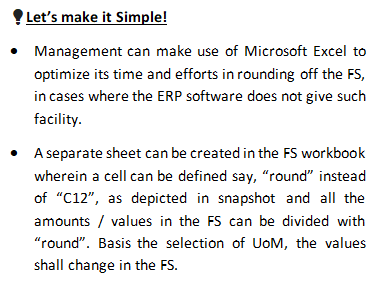
| Common unit of measurement (UoM) to be applied across the complete set of FS including Annual Report and must be categorically disclosed. Ensure there are no casting errors Appropriate disclosure to be given in places where the rounded off amount is less than UoM applied. E.g. Asterisk (*) indicates amount less than UoM applied Rounding off to be applied only on amounts / value and not on quantity. (E.g. Number of shares should not be rounded off). However, earnings per share shall not be rounded off. | Maintain two sets of FS one set of FS in absolute numbers for ITR and/or ROC purpose other set of FS in rounded off User readability of FS for its comparability and analysis across sectors / industries In case of consolidation, practical challenge is faced when various entities within the Group follow different UoM. Authors’ View: Common UoMcan be followed within the Group to ensure hassle-free process of consolidation. |
Auditor’s procedures, considerations and documentations:
· Amounts reported in the audit report must also be rounded off using the same UoM as applied for preparation and presentation of the FS.
2. Share Capital
| Precautions | Challenges |
| * Ensure adequate disclosure vis-à-vis Share Capital, terms and rights, reconciliation, promoter shareholding, more than 5% shareholding, etc. is provided for every class of equity and preference shares separately. * Details of promoters shareholding in FS shall be in sync with Annual Return (Form MGT-7/ MGT-7A). * In case of newly incorporated companies, change in promoters shareholding shall be calculated from date of initial subscription. * Employee Share-based Payments, Stock Options Outstanding Account should be disclosed as a separate line-item. The Schedule III requires this item to be shown as a part of ‘Reserve and Surplus’. * In case of any change in authorised capital, ensure Memorandum of Association (MoA) is amended to give effect thereof. * In case of private placement of shares, ensure funds are collected in a separate bank account and are not utilised until return of allotment in Form PAS-3 is filed with ROC. | * Disclosure in authorised share capital wherein: Resolution for change in authorised share capital has been passed before reporting date. However, Form SH-7 is filed subsequently i.e. after reporting date Authors’ view: Since the resolution has already been passed, revised share capital to be disclosed. * Disclosure in issued, subscribed, paid up share capital for a newly incorporated company wherein: Only part subscription amount is received before reporting date; balance amount is received subsequently i.e. after reporting date Authors’ view: Total amount of subscription must be disclosed as per Memorandum of Association; irrespective of amount actually received before reporting date. * Disclosure in case of merger/ de-merger: In case where the scheme of merger/ de-merger is approved before the reporting date; however, shares are issued subsequent to the reporting date Authors’ view: Issued shares to be disclosed as ‘Share Suspense’ as a separate line item after Share capital but before Reserves & Surplus. |
Auditor’s procedures, considerations and documentations:
· Auditor shall refer to the Articles of Association (AOA) and MoAof the Company, altered AOA and MOA, if any and master records from MCA website.
· Auditor must verify whether the promoter shareholding disclosed is in accordance with the term ‘Promoters’ as defined in the Companies Act, 2013.
· Alternatively, the auditor can refer to the Annual Return i.e. Form MGT-7/ MGT-7A filed by the Company for the previous reporting period.
· Review the minutes of board and shareholders’ meeting for the interim changes, if any.
· The auditor must obtain management representation stating the shareholding of each class of shares along with promoter details.
· Valuation report where shares are issued on private placement.
3. Borrowings (Current & Non-Current)
| Precautions | Challenges |
| * The classification of loans between current and non-current shall be predominantly on the basis of loan agreement. * Nature of security shall be specified separately in every borrowing. * Terms of repayment of term loans and other loans shall be disclosed in FS. * Period and amount of continuing default (for principal and interest) as on the reporting date shall be specified separately in each case. * Current maturities of all long-term borrowings will be disclosed under ‘short-term borrowings’. * Reporting disclosure for utilisation of amount raised from banks and financial institutions must be based on the overall position of balance sheet at the reporting period. Ensuring that all related details pertaining to utilisation and methodology adopted along with necessary workings prepared by the management are available for auditor’s verification. * Details of charge (creation/modification/ satisfaction) against borrowings to be disclosed and the same must be registered with ROC within the stipulated time. If not registered within stipulated time, separate disclosure is required. * Quarterly reconciliation of security-wise and lender-wise disclosure between the amounts reported in quarterly statements and amounts reflected in books of accounts for borrowings sanctioned by banks and / or financial institutions on the basis of security of only current assets. – These borrowings may be during any point of time of the year. Sanction should include fresh sanction, limits renewed as well as limits due for renewal during the reporting period. – Disclosure is required for both fund based/ non-fund based credit facilities. * Interest accrued and due/ Interest accrued but not due on borrowings must be separately disclosed under Other Current Liabilities. | * Classification of a particular loan as a term loan: Authors’ view: Term loans normally have a fixed or pre-determined maturity period or a repayment schedule and need not be restricted to a period of 36 months which is otherwise defined as 36 months in CARO 2020. * Ensuring appropriate utilisation of long term borrowings for long term purposes and specified borrowings for specified purposes. Authors’ Comment: Where the funds are received in a common bank account, management can analyse the movement/ utilisation of funds based on the overall position of balance sheet at the reporting period and maintain adequate documentation.Onus will be on the Company to prove that funds were utilized for the purpose of borrowing. * Disclosure requirement if the funds were parked temporarily until the actual utilization of funds raised from banks and financial institutions Authors’ view: The same shall be construed as borrowings not utilised for specific purposes and details of investment must be specified. * Obtaining data for disclosures pertaining to wilful defaulter. The same is available from RBI website. Alternatively, the company can obtain CIBIL report at the end of reporting period. * Utilisation of borrowed funds and share premium by way of an investment or providing guarantee or security or advancement of loan to Ultimate beneficiary through an Intermediary. – Tracking of money trail will be complex where the entities are not related. – Disclosure is required for each level of intermediary making it all the way more tedious and time consuming exercise – Obtaining declarations from each such intermediary that they are compliant with PMLA and FEMA, if applicable. |
Auditor’s procedures, considerations and documentations:
· The auditor shall verify the above judgements, estimates and assumptions made by the management for various disclosures as covered above.
· The auditor shall duly verify all the loan agreements; Form CHG-1, Form CHG-4, details of moratorium and accounting thereof (including the TDS implications during moratorium, if any)
· If the company has defaulted in repayments of loans or borrowings, it shall report the same in its Audit Report in the prescribed format.
· Care must be taken that this reporting is applicable for all types of lenders and not restricted to banks and financial institutions
· Where a loan is borrowed from any entity or a person to meet the obligations of its subsidiaries, associates or joint ventures, the auditor must ensure that the funds have been utilized for the said purpose by obtaining a CA certificate (preferably statutory auditor) from such subsidiaries, associates or joint ventures.
· The auditor shall verify the “nature of security” as per the sanctioned loan agreement or term sheet along with the physical verification of security certificates, where investment in securities ofits subsidiaries, joint ventures or associate companies is pledged for obtaining any loans.
· The auditor shall adhere to SA 505 “External Confirmations”
· It must be ensured that the loans obtained are within the borrowing powers of the entity by complying with the provisions of Companies Act, 2013 and rules thereof [Section 180(1)(c), where applicable].
4. Trade Payables (Current & Non-Current)
| Precautions | Challenges |
| * The amounts due under contractual obligations cannot be included within Trade payables. Such contractual obligations may include dues payables in respect of statutory obligations like contribution to provident fund, purchase of Property, Plant and Equipment, Intangible Assets, etc. * MSME disclosure: The disclosure is only for micro and small enterprises and not for medium enterprises. * Ageing details: Disclosure for ageing analysis is broadly categorised into: outstanding amounts which are unbilled, not due and due over specified periods; and classified between disputed and undisputed dues. – Even though the disclosure requirements states amount due to MSME, the disclosure must be only for Micro and Small Enterprises. – In case of amalgamation/merger – Original date will be considered for the purpose of giving information. If such information is not available, the fact should be so stated. – In case due date for payment to vendors is not maintained in the accounting software, transaction date i.e. date of recognising liability in books of accounts can be considered as the due date for payment. * Ageing Schedule shall anchor as an indicator for accounting of write backs, if any. In case of any write backs, corresponding effect of reversal of indirect taxes, if any must be complied with. | * Information of vendors registered as Micro and Small Enterprise. * Rate of Interest on delayed payments (beyond 45 days) = 3 times the Bank rate notified by RBI Authors’ Comment: RBI Bank rate can be obtained by selecting the appropriate week and referring the “Ratios and Rates” file from the following RBI website: https://www.rbi.org.in/Scripts/BS_ViewWss.aspx * Provision of interest in cases where the payment was outstanding for a period more than 45 days, but not outstanding as on the reporting date. * Whether the balance confirmation obtained from MSME vendors would suffice in case interest is not accounted for in the FS where the payment was due for more than 45 days? Authors’ View: If the management categorically mentions the fact that interest is not provided and the party confirms the same, the management shall disclose this fact in FS for not providing such interest, else it may have to disclose the same as a contingent liability. * Ageing Details – Whether amounts outstanding for a substantially long period of time are to be disclosed as disputed or not? Authors’ View: In cases where evidence can corroborate the fact of existence of a dispute, only then the same must be disclosed as disputed dues. |
Auditor’s procedures, considerations and documentations:
· Evaluate internal control procedures viz. quotations for purchase orders, walk through process for purchases accounting, credit period policy from different vendors, etc.
· The auditor shall perform cut-off procedures to confirm that all the transaction for the year under review have been duly accounted.
· The auditor shall obtain external confirmationsfor the type of vendor i.e. whether registered as MSME, the amount outstanding as on the reporting date. In case of any discrepancy in the balance confirmation, the auditor shall verify how the un-reconciling items are dealt by the management in its FS.
· The auditor can verify the parameters captured for generating the Ageing report from the ERP system on test check basis.
· Based on ageing analysis, the auditor shall conduct enquiry with the management regarding the payment plan and/or any write backs, if any.
· In case of disputed dues, the auditor may obtain the necessary documentary evidence to verify the claim of the management and simultaneously verify contingent liability, if any.
5. Property, Plant and Equipment and Intangible Assets
| Precautions | Challenges |
| * A separate disclosure is required for all leased assets. * Reconciliation of gross and net carrying amounts of each class of assets indicating additions, disposals, acquisitions through business combinations, amount of change due to revaluation and other adjustments (As per AS-11/ AS-16) and the related depreciation and impairment losses/reversals is to be provided. – Any adjustments due to business combinations/ demergers, must be separately disclosed. * Separate disclosure is required in cases where title deeds of immovable property are not held in the name of the Company as on the reporting date. – These could be cases where documents are under preparation or registration process of transfer of name is in progress or due to a dispute, or on account of merger/ demerger/ conversion. – If such property is jointly owned, disclosure will only be to the extent of company’s share. * Benami property shall be separate disclosed. * Impairment of property, plant and equipment and Intangible Assets must be tested annually. | * Whether disclosure is required where immovable property is held as inventory but not in the name of the Company. Eg. Real estate business Authors’ View: No such disclosure is required. * Benami property held by the Company – Beneficiary details may not be easily available – There would be practical challenge in identifying a property if the same is not maintained in the books of accounts. * Disclosure requirements in case of revaluation: – Schedule III requires separate disclosure if revaluation change is 10% or more in aggregate of the net carrying value of each class of Property, Plant and Equipment. However, AS 10 requires separate disclosure irrespective of % change in revaluation. – Further, this disclosure is required to be stated for a period of five years as per Schedule III. However, AS 10 stipulates this disclosure requirement as long as the asset is held by the company. – In such conflicting cases, AS shall prevail over Schedule III. |
Auditor’s procedures, considerations and documentations:
· The auditor should verify the records with reference to the documentary evidence such as orders, invoices, receiving reports, title deeds, applicable GST documents, lease or hire purchase agreements, minutes of the Board meetingand by evaluation of internal controls.
· The auditor must obtain and make a sanity check of the valuation report in case of revaluation.
· Auditor shall verify the impact of revaluation of assets on deferred tax, if any .
· Auditor must be vigilant while performing verification for identifying benami property, if any by adopting additional procedures viz. reviewing the minutes of the meeting, any unusual legal or professional charges incurred, any expenditure pertaining to maintenance charges for a property which is neither owned nor rented, inquiries from the management, etc.
· Auditor must review the certificate obtained by the management from technical expert in cases where useful life or residual value estimated by the management differs from the details prescribed under Schedule II of the Companies Act, 2013.
· In cases of business combination/ amalgamation/ de-merger, auditor must verify the scheme of arrangement to assert the correctness, accuracy and valuation at which assets are accounted for in
the books of accounts. Further, in case if title deeds are not registered in the name of the resultant entity, the auditor will have to disclose the relevant details in his audit report.
· Auditor must verify the FAR maintained by the management and must ensure physical verification of such assets to assert on the existence and accuracy via observation or re-performance followed by annual impairment testing.
6. Capital Work-in-Progress (CWIP) and Intangible Assets under Development (IAD)
| Precautions | Challenges |
| * Capital advances should be included under Long-term loans and advances and not under capital work-in-progress. * Ageing Schedule to be provided duly classified between projects in progress and projects temporarily suspended as on each reporting date. – Classification of projects temporarily suspended must be in sync with AS 16 and corresponding capitalisation of borrowing costs on such projects must be suspended. – In case of amalgamation/merger – Original date will be considered for the purpose of giving information. If such information is not available, the fact should be so stated. * Project-wise completion schedule to be disclosed where period was overdue or cost was over-run as compared to the original plan. * Impairment must be tested annually. | * What constitutes a Project? Authors’ Comment: The term project is subjective and management may exercise it’s best judgement in identification of a Project. The methodology once adopted must be consistently followed. * Whether previous year’s amounts to be re-classified in case if a project was classified as work-in-progress in the previous year; but was temporarily suspended during the year? Authors’ Comment: No. Amounts of previous year to be continued as work-in-progress; whereas current year amounts will be disclosed as progress under temporary suspension. * Original plan vs. revised plan Authors’ View: Plans shall include management’s estimates and assumptions w.r.t future business, economy / industry and regulatory environments and such assumptions may be subject to change from time to time resulting in a ‘revised plan’. Management shall apply judgement in determining whether such revisions are in the nature of a fresh ‘Original Plan’ or simply an update of estimates and assumptions. |
Auditor’s procedures, considerations and documentations:
· The auditor must obtain an understanding of how the management has derived in identification of a project.
· Auditor must inquire with the management for future viability of the CWIP that are overdue in period or where there is cost over-run.
· There may be instances of difference in opinion between auditor and management with respect to whether a project is in progress or is temporarily suspended. In such cases, depending on facts and circumstances of the case, auditor may provide a modified opinion in his audit report.
7. Investments (Non-Current and Current)
| Precautions | Challenges |
| * Valuation of investment: – Non-current investments must be valued at cost in accordance with AS-13 unless there is a decline in the value of a long-term investment being other than temporary decline. Diminution in the value of investments must be disclosed under the relevant heads separately. – If non-current investments are valued at other than cost, the basis of valuation for each individual investment should be disclosed. – Current investments must be carried at lower of cost or fair value in accordance with AS-13 which is determined either by category of investment or on an individual investment basis. However, the valuation must not be on an overall basis. * Aggregate cost and market value of quoted Investments along with aggregate amount of diminution in value of investments must be disclosed. * In case of investment in partnership firm, details of partners’ contribution and share must also be separately disclosed. * In case additional costs are incurred for acquiring such investments, the same must be added to the cost of investments. | * Valuation of current investments in an unlisted entity may pose to be a challenge, as fair value may not be readily available. * Identification whether decline in fair value of current investment is temporary in nature or otherwise could be a challenge. Mere de-listing of an investment may not tantamount to diminution in the value of investments. Various scenarios must be envisaged. * While acquiring an unlisted investment, management shall procure valuation report in accordance with the requirement stipulated under section 56(2)(x) of the Income Tax Act, 1961 as it may impact the computation of provision for current taxes. * In case where an investee entity viz. Company is subsequently converted into a LLP, what shall be the treatment for premium paid during original acquisition. Authors’ View: The fixed capital contribution is restricted to the amount of face value of the share held in the erstwhile Company and the excess premium would be treated as a separate line item under Investment. |
Auditor’s procedures, considerations and documentations:
· Auditor must verify all relevant documentation for asserting on the ownership and existence of the investment. Valuation report must also be verified where necessary. Auditor must obtain external confirmations in case of investment in partnership firms.
· In case of investment in a group entity, auditor shall test for impairment by calling for financial information of all such entities in the group
· Auditor must also ensure that the Company has complied with Section 186 and Section 188 of the Companies Act, 2013.
· Review the minutes of board and shareholders’ meeting for the interim changes vis-à-vis investments, if any.
8. Loans and Advances (Non-Current and Current)
| Precautions | Challenges |
| * The company must disclose the relationship of the person to whom loans are advanced, if such person is a promoter, director, key managerial person or a related party. Such relationship must exist on the date of advancement of loan and not as on the reporting date. * The Company shall ensure that the loan agreement contains the purpose for advancing such loan along with the requirement of obtaining Annual Statutory Auditor’s certificate for utilisation of such funds by the borrower. * Where the Company has advanced any loans, it shall ensure that the provisions of Section 185 and 186 of the Companies Act, 2013 and Section 2(22)(e) of the Income Tax Act, 1961 are duly complied with. * When a company not being a Non-Banking Financial Institution has advanced any loan it shall ensure that the provisions of Non-Banking Financial Institution norms are not violated i.e. it’s – Non-finance income does not exceed 50% of gross total income and – Non-finance assets does not exceed 50% of it’s total assets. * In case of a Non-Banking Financial Institution where the loan has turned bad or doubtful, the Company shall comply with the IRAC Norms and disclose such assets as non-performing/ sub-standard/ doubtful or loss assets; and accordingly appropriate provisions must be accounted for. * Where the loan has turned bad or doubtful and interest income is accounted for on receipt basis, the fact must be appropriately disclosed under it’s significant accounting policy. | * Can advances be interpreted as loan given? Authors’ View: The interpretation of whether advances are in the nature of loans shall depend upon facts and circumstances of each case. Simply charging of interest on advances need not imply that advances are in the nature of loans. * Where the Company has advanced any loans to it’s promoters, directors, key managerial persons or related parties which are either repayable on demand or where the agreement does not specify the relevant terms of loan, the said fact shall be disclosed separately group wise. Authors’ Comment: In case director is also a promoter and / or KMP, management can follow hierarchy of command i.e. Promoter followed by director followed by KMP. In this case, it is recommended to disclose person as Promoter. * Where there are multiple advancement of loans to a single party and the relationship of such party has changed over the period from the date of advancement of loans upto the reporting date, identification of relationship at each point in time may prove to be a challenging and time-consuming task. In such case, the resultant disclosure may be absurd. * Utilisation by the recipient of funds and share premium by way of further investment or providing guarantee or security or advancement of loan to ultimate beneficiary – Tracking of money trail will be complex where the entities are not related. – Disclosure is required for each level of intermediary making it all the way more tedious and time consuming exercise – Obtaining declarations from each such intermediary that they are compliant with PMLA and FEMA, if applicable. |
Auditor’s procedures, considerations and documentations:
· Obtain a list of related party relationship from the management with categorical bifurcation between promoter, director and key managerial personnel.
· Verify relevant loan agreements.
· The auditor must substantiate his audit procedures based on the end use certificate issued by a Chartered Accountant.
· Auditor must verify whether provisions for bad and doubtful loans and advances are appropriate.
· The auditor shall adhere to SA 505 “External Confirmations”.
· Auditor must also ensure that the Company has complied with Section 185 and Section 186 of the Companies Act, 2013.
· Review the minutes of board and shareholders’ meeting for the interim changes, if any.
9. Trade Receivables
| Precautions | Challenges |
| * Ageing details: Disclosure for ageing analysis is broadly categorised into: outstanding amounts which are unbilled, not due and due over specified periods. The disclosure is further classified into: – disputed / undisputed dues – considered good/ doubtful * Ageing Schedule shall anchor as an indicator for accounting of provisions/ impairment, if any. | * Ageing Details – Whether amounts outstanding for a substantially long period of time are to be disclosed as disputed or not? Authors’ View: In cases where evidence can corroborate the fact of existence of a dispute, only then the same must be disclosed as disputed dues. – If due dates for receipt from customers are not maintained in accounting software Authors’ Comment: The transaction date i.e. date of recognising income in books of accounts can be considered as the due date of payment. |
Auditor’s procedures, considerations and documentations:
· Evaluate internal control procedures viz. walk through process for sales accounting, credit period policy for different customers, etc.
· Perform cut-off procedures to confirm all transaction for year under review have been duly accounted.
· Obtain external confirmations for amount outstanding as on reporting date. In case of any discrepancy in balance confirmation, auditor shall verify how un-reconciling items are dealt with by the management in its FS.
· The auditor can verify the parameters captured for generating the Ageing report from the ERP system on test check basis.
· Based on ageing analysis, the auditor shall conduct enquiry with the management regarding the collection and follow-up plan, ongoing legal cases and/or write offs, if any.
10. Relationship with Struck Off Companies
| Precautions | Challenges |
| * Management shall disclose the name of struck off company, nature of transactions with such struck off company, balance outstanding as on reporting date and relationship with such companies, if any. * The above disclosure is required even when the balance outstanding at the end of reporting period is Nil but the transaction with struck off company has occurred during the year. * Where the company is under insolvency process, the same shall not be disclosed as it cannot be considered as struck off company. * In case of change in relationship status, the status prevailing as at the end of the reporting period shall be disclosed. * Gross Carrying amount of transaction (without netting off provision for doubtful debts or impairment loss allowance) shall be disclosed. | * Gathering the data of struck off companies (from MCA database) is a tedious and time consuming process. * What if company is struck off during the year but has been restored? – Disclosure is not required if it is restored before signing of FS. * How to disclose comparative earlier year reporting period’s figure, where the company is struck off during the reporting period? – “N.A.” can be mentioned for the comparative previous year along with a note stating that “since the company was struck off during the current reporting period, there is no comparative figure of previous year disclosed”. |
Auditor’s procedures, considerations and documentations:
· Inquire about the processes applied by the management in deriving the companies that are struck off and obtain necessary documentation (e.g. screenshots of MCA Company Master data of such parties) and ensure that reporting of such transactions is upto the date of signing FS and not as on the reporting date.
· Verify the implications of transaction entered with struck off companies and the corresponding implication on the existence of such asset or liability, as the case maybe, post conducting enquiry with the management (E.g. Check for impairment in case of any investments with struck off companies.)
11. Analytical Ratios
| Precautions | Challenges |
| * All ratios are applicable to all companies that are governed by the Companies Act, 2013, irrespective of any exemptions specified in any other laws. * The formulae prescribed in Guidance note on Schedule III is only recommendatory in nature. Management may adopt any other methodology in deriving the ratios by factoring in the company specific and industry specific nuances. * There are ratios where average inventory, trade receivables, trade payables and working capital are required as denominator. – In case of first year of the company, closing amounts needs to be used instead of average amounts; since average amounts will not be available. – In second year, closing amounts must be used instead of average amounts; to enable comparability. Adequate disclosure must be provided indicating reason for using closing amounts instead of average amounts. – From third year onwards, management can use average based formulae and provide an adequate disclosure stating previous year’s ratios are re-computed for comparability. | * Whether ratios must be disclosed as favourable/ adverse? Authors’ View: Management may disclose ratios as favourable/ adverse. However, it is recommended that consistent method is followed for disclosing variance of each and every ratio i.e. Output of Current year’s figures – Output of Previous year’s figures or vice versa; without stating favourable / adverse remark. * When numerator and denominator of a ratio are both in negatives, whether the ratio would be disclosed as positive/ negative? Authors’ View: The ratio would be disclosed in negative. * Owing to complexity of formula for determining the return on investment that is prescribed in the Guidance note on Schedule III, it is recommended that Management shall make suitable adjustments to the formulae and make appropriate disclosures. e.g.: (Current value of investment – Initial Value of Investment)/ Initial Value of Investment x 100 |
12. Other Points
· Cash and Cash Balances:
Cash and cash balances are broadly categorised into Cash and Cash Equivalents and Other Bank Balances as under:
o Cash on hand, cheques on hand, balance in banks that are free from lien: Cash and Cash Equivalents
o Bank balances that are held as margin money or security against borrowings: Other Bank Balances
o Unpaid dividend account: Other Bank Balances
o Bank deposits where:
§ Original maturity < 3 months: Cash and Cash Equivalents
§ Original maturity < 3 months but lien is marked: Other Bank Balances
§ Original maturity > 3 months but maturity is on or before 12 months from the Reporting date: Other Bank Balances
§ Maturity > 12 months from the Reporting date: Non-current Assets
· Deferred Tax Asset / Liability:
o Management shall ensure that the deferred tax assets and liabilities are measured using the tax rates and tax laws that have been enacted or substantively enacted as at the reporting date.
o Recognition of deferred tax assets (DTA):
§ In case an enterprise has unabsorbed depreciation or carry forward of losses under tax laws à Recognition of DTA to the extent that there is virtual certainty supported by convincing evidence that sufficient future taxable income will be available against which such DTA can be realised.
§ In any other cases à Recognition of DTA to the extent that there is a reasonable certainty that sufficient future taxable income will be available against which such deferred tax assets can be realised.
· Disclosure of Crypto Currency or Virtual Currency:
o In case the company has traded or invested in virtual currencies, it shall disclose:
§ Profit / loss on such transactions
§ INR amount of currency held at the reporting date
§ Deposits or advances from any person for the purpose of trading or investing in Crypto Currency / Virtual Currency
· Undisclosed Income:
o Company shall disclose such income separately in FS where it has voluntarily admitted to the addition of erstwhile unrecorded income, which can be demonstrated on the basis of the search report.
o In case the addition is made by the income tax authorities and the company has disputed such additions, the above disclosure shall not be applicable.
o Even where the company chooses not to file an appeal, it cannot be presumed that the company has surrendered or disclosed the income.
o In case of consolidated FS, the holding company shall disclose the names of each such subsidiary / group entity that has an undisclosed income. Further. if associate company has undisclosed income, then the Holding Company should disclose if such income is material to the group.
· Corporate Social Responsibility:
o The reporting of Corporate Social Responsibility of the Company in the notes to accounts forming part of the FS must be in line with the reporting in Director’s Report.
· AS based and other disclosures (Illustrative list):
o AS-7, AS-15, AS-16, AS-17, AS-18, AS-19, AS-20, AS-29
o Contingent liability and capital commitment
o Earnings and expenditure in foreign currency
Conclusion:
To sum up, all the amendments made in Schedule III are intended to increase transparency and reliability of FS to the userswhich is of paramount important considering the investor confidence in FS is dwindling due to an increase in instances of fraud and non-compliance.