
Audit Conclusion & Reporting
SA 700 series is a set of auditing standards issued by the ICAI that deal with the auditor’s responsibility to form an opinion on the financial statements and to report on those financial statements.
The SA 700 series of standards is broadly divided into three standards:
- SA 700 – Forming an Opinion and Reporting on Financial Statements
- SA 701 – Communicating Key Audit Matters in the Independent Auditor’s Report
- SA 705(Rev)- Modifications to the Opinion in the Independent Auditor’s Report
In this Article, we shall cover SA 705 which deals with the auditor’s responsibility to issue an appropriate report in circumstances, when auditor is required to issue a modified opinion (i.e. qualified opinion or adverse opinion or disclaimer of opinion).
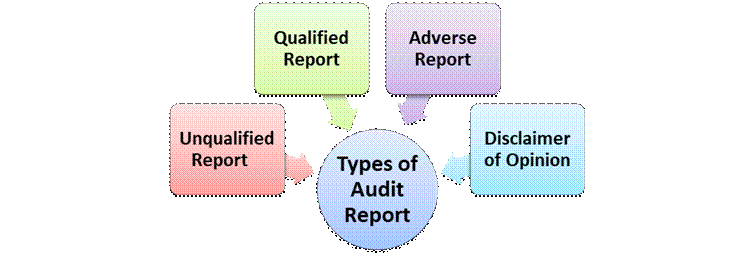
Since, we all are well versed with the Theoretical part of all the SAs, let us start with the Conclusion.
What are the circumstances when a modification to the auditor’s opinion is required under SA 705:
- Material misstatement– A material misstatement is an error or omission that, individually or in the aggregate, could reasonably be expected to influence the economic decisions of users taken on the basis of the financial statements.
- Scope limitation – A scope limitation is a restriction on the auditor’s ability to obtain sufficient appropriate audit evidence.
- Uncertainty – The auditor must modify the opinion if there is an uncertainty that is material, pervasive, and relevant to the financial statements. An uncertainty is a matter about which there is a high degree of doubt that may cast significant doubt on the ability of the entity to continue as a going concern or the accuracy of the financial statements.
The table below illustrates how the auditor’s judgment about the nature of the matter giving rise to the modification, and the pervasiveness of its effects or possible effects on the financial statements, affects the type of opinion to be expressed.
| Nature of Matter | Auditor’s Judgment about the Pervasiveness of the Matter | |
| Material but Not Pervasive | Material and Pervasive | |
| Financial statements are Materially misstated | Qualified opinion (…Except for…) | Adverse opinion (… do not represent true & fair…) |
| Unable to obtain sufficient appropriate audit evidence | Qualified opinion (…Except for…) | Disclaimer of opinion (… we do not express an opinion…) |
What is Pervasive? – Pervasive effects on the financial statements are those that, in the auditor’s judgment:
- Are not confined to specific elements, accounts or items of the financial statements;
- If so confined, represent or could represent a substantial proportion of the financial statements; or
- In relation to disclosures, are fundamental to users’ understanding of the financial statements.
What is material misstatement? - SA 450 defines a misstatement as a difference between the amount, classification, presentation, or disclosure of a reported financial statement item and the amount, classification, presentation, or disclosure that is required for the item to be in accordance with the applicable financial reporting framework.
Accordingly, a material misstatement of the financial statements may arise in relation to:
- The appropriateness of the selected accounting policies;
- The application of the selected accounting policies; or
- The appropriateness or adequacy of disclosures in the financial statements.
Thus, based on the above, the auditor shall express an unmodified opinion when the auditor concludes that the financial statements are prepared, in all material respects, in accordance with the applicable financial reporting framework.
If the auditor concludes that, based on the audit evidence obtained, the financial statements as a whole are not free from material misstatement; or is unable to obtain sufficient appropriate audit evidence to conclude that the financial statements as a whole are free from material misstatement, the auditor shall modify the opinion in the auditor’s report in accordance with SA 705 (Revised).
Interesting Facts on Audit Qualifications:
It is interesting to note that according to a research conducted by the Centre for Audit Quality Directorate (CAQD), 73% of the all the modifications are centred around 5 core themes of:
- Going Concern
- Financial Instruments
- External Confirmation
- Consideration of Laws & Regulations
- Recording of Provisions, Contingent Assets & Liabilities
The CAQD in its Key Findings found out the broad reasons for Modified Opinions expressed in Audit Reports are categorised under the following heads:
- SA 250-Consideration of Laws and Regulations in an Audit of Financial Statements: The auditors had expressed modifications owing to non-compliance of various provisions of Companies Act 2013, FEMA, Income-tax Act, GST, SEBI & RBI rules pertaining to NBFCs.
- SA 505-External Confirmations: The auditors were unable to obtain confirmation from Third Parties to validate and confirm the balances as reflected in the financial statements.
- SA 570-Going Concern: The auditors were of the opinion that material uncertainty existed in relation to the going concern status of the entity.
- Ind AS 19-Employee Benefits: The auditors had expressed modifications owing to non-compliance of the requirement under Ind AS 19 pertaining to employee benefits which include actuarial valuation, payments etc.
- Ind AS 36-Impairment of Assets:Either the impairment testing was not carried out by the management or the auditors were unable to comment on appropriateness of impairment assessments as undertaken.
- Ind AS 37-Provisions, Contingent Liabilities and Contingent Assets: The auditors had expressed modification owing to non-creation of provision under Ind AS 37, further in few cases matter was sub-judice and / or disputed.
- Ind AS 109-Financial Instruments: Either there was non-recognition/ provision of interest amount or non-reconciliation/ confirmation of balances or non-provisioning in the context of Expected Credit Losses.
- Corporate Insolvency Resolution Process (CIRP) Under IBC: The companies were under the process of CIRP or were in the process of initiating insolvency proceedings.
- Internal control over financial reporting (ICoFR): The auditors were of the opinion that either the internal controls were not operating effectively, or the companies had inadequate internal control.
Thus, by examining the circumstances that give rise to modified opinions, the auditor should aim to promote transparency and accountability, enabling stakeholders to make informed decisions based on a deeper understanding of the financial health of an entity.