
SUCCESS STORIES – CA HERIN SHAH
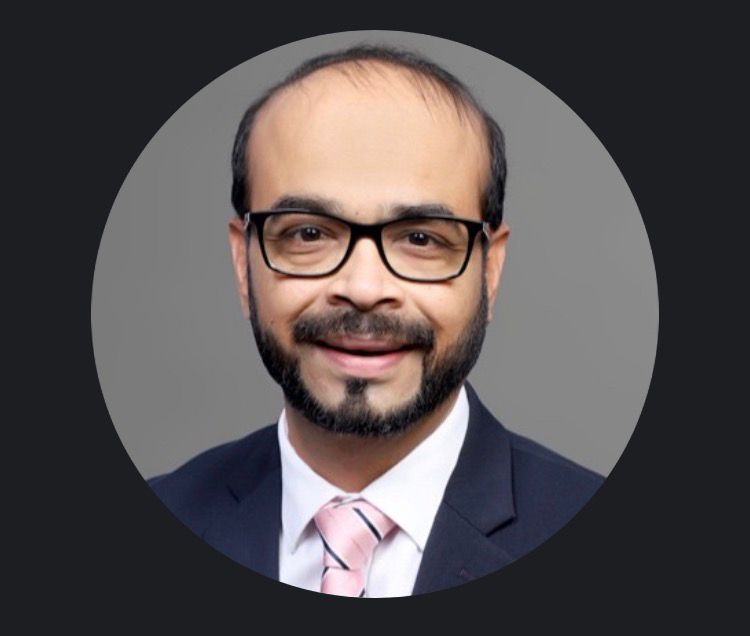
– CA HERIN SHAH
“Plan A, Plan B, and a Curious Mind”
Chief Investment Officer at JioBlackRock Wealth, Herin Shah, on cricket bats, chess boards, fifteen years in London, the maths paper that almost broke him — and the three philosophies that have quietly run his career.
Q. If you had to describe your journey in one line, what would it say?
Life so far has been a combination of planned and random events. While ambition and effort are the main ingredients — luck is the garnish.
Q. Where did you grow up, and who is in your family?
I was born and raised in Mumbai, with roots in Faradi village, Kutch. My father, Girish Shamji Shah, was a banker; my mother, Smita Umershi Gala, a science graduate. My wife Nikita is a teacher, and we have two daughters — Eia, twelve, and Riva, nine.
Q. What did you study — and did your career follow that path, or take a detour?
I am a Chartered Accountant — cleared in the first attempt with an All India Rank in the Finals — and I subsequently completed FRM and Company Secretaryship as well.
The interesting part is what came before that. I was genuinely strong in science, but I chose commerce, primarily so I could keep playing sports. From Grade 6 onwards, I represented school, college and clubs in cricket and chess, with athletics and badminton on the side. I never missed a sporting competition — though I may have missed a few exams along the way. I was reasonably good at sports but was able to balance academics too.
My parents had the foresight to push me towards sports rather than away from it, and I remain grateful. Without that, I would have spent a lifetime regretting the youth I never gave to the game.
So taking commerce and pursuing CA was more an outcome of accommodating sports in my preference rather than active choice. Science is what I had in mind during school days.
Q. How did your career actually begin — and what was your first real break?
I did my CA articleship at KPMG, and just a month after my final exams, I had the opportunity to move to London. That move was the break.
I spent my first seven years at Goldman Sachs London, eventually as Executive Director in the Advisory division. I then joined Invesco Asset Management in London for eight years on the Multi-Asset Investments team. After fifteen years in London, I returned to India as a Multi-Asset Fund Manager with Invesco India, and five years later took up my current role as Chief Investment Officer at JioBlackRock Wealth.
Q. What were the two or three decisions that defined your professional path the most?
My career has stayed largely within Investments domain. I have deliberately worked across asset classes — equities, bonds, commodities, derivatives, distressed opportunities — and across India, Emerging Markets, Europe and the US. I am always curious to understand how things work and how they fit with each other. Chess to a large extent helped me to think logically about things and understand risk and reward dynamics.
Early on, I genuinely did not know what I wanted to be or where my real edge lay. So I did the only thing that felt honest: (1) I kept a curious mind, (2) met as many different kinds of people as I could, and learned from them. Clarity, for me, did not arrive as a sudden insight about what I wanted. It arrived in my mid-thirties, as a much quieter realisation about what I did not want to do.
Q. What is the toughest setback you have faced, and what did it teach you?
It was Grade 12 at NM College. That year, our college reached the inter-college finals in both cricket and chess — I was in both teams — and I had decided not to take a single external tuition or classes. A month before the Board exams, the college held its prelims. I scored 36 in Maths and barely passed.
It was a frightening moment. Friends were deep into Board and CA entrance preparation, I had no classes or tuitions to fall back on, and the failure played on my mind. The lesson was clear and permanent: when you are doing several things at once, a high-level plan is not enough. You need a detailed plan — and just as crucially, a Plan B.
For the record, I ended up scoring 90+ in Maths in the actual Board exams which were three weeks after the prelim exams. Purely because of detailed planning, sharp focus and relentless execution of the plan.
Q. What are the three philosophies that have most helped you in life?
Honestly at different stages of life, you get inspired and influenced by different things and different people. Hence your philosophies can and should adapt. But three things have largely been constant and helped me:
(1) Try to be the best at whatever you do.
(2) Have a growth mindset — stay curious about everything.
(3) And always have a Plan B.
Q. If you had to distil your career into a few lessons, what would they be?
Careers for most people are combination of circumstances and luck and mine is no different. Rare few have clarity from early on and every effort is in that direction. I feel three things are under-ratedin terms of their impact:
- writing down your goals and dreams and seeing them frequently;
- finding balance in life (it looks different for everyone, but it matters); and
- meeting people from varied fields and learning from them.
And two that are over-rated:
(1) chasing marks and grades — too many classes and tuitions can rob children of life-exploration time and it matters later on in life; and
(2) the blanket “positive attitude” doctrine. I would argue for a pragmatic attitude instead.
Q. Did you have role models?
Yes — different ones at different stages, and almost all of them sports people, along with a few from family and friends. Role models are powerful for motivation and driving effort. They are also invaluable when you are confused in decision making or have moral dilemas.
Q. Three books that have stayed with you?
I was always big into reading any and every kind of genre. My favourite three books (again reflecting different genres) are:
- Out of My Comfort Zone by Steve Waugh
- Lord of the Rings trilogy
- Thinking, Fast and Slow by Daniel Kahneman.